Introduction
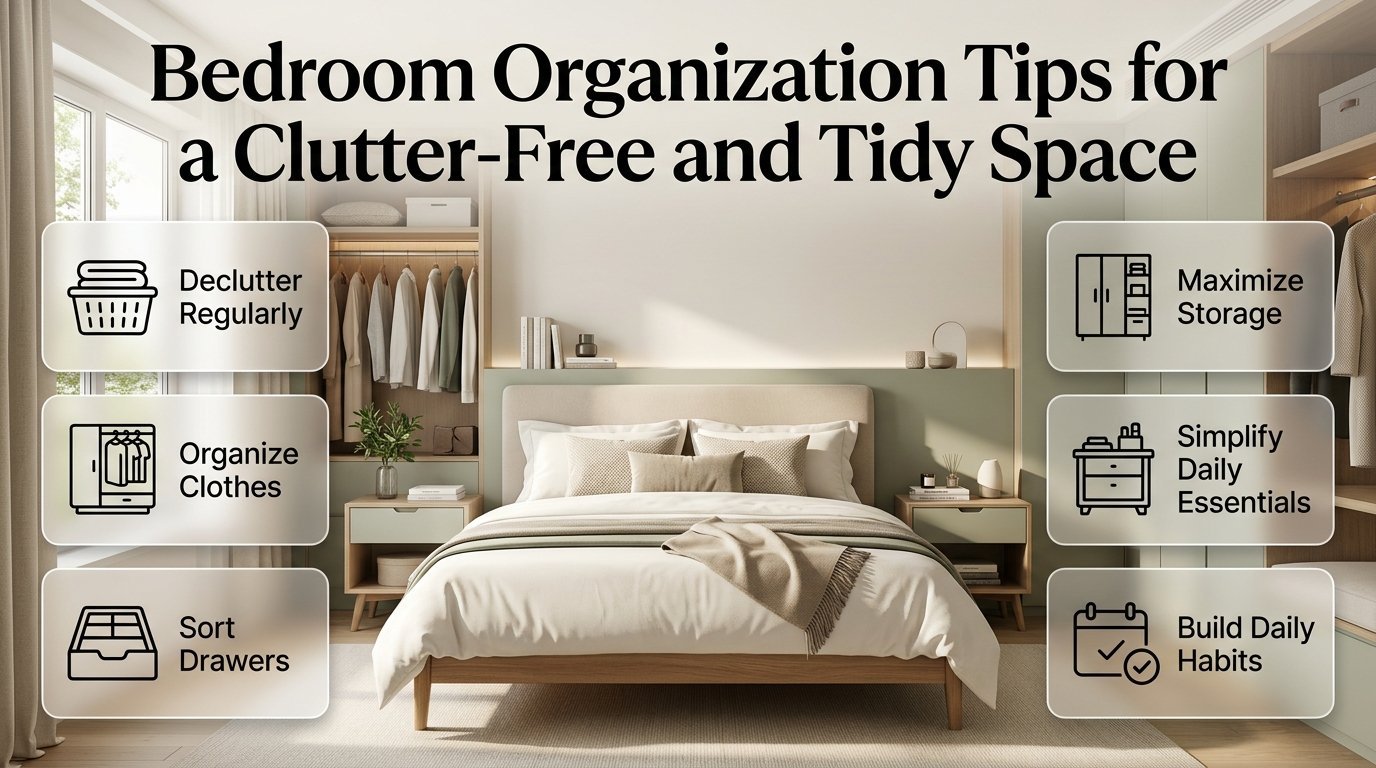
Bedroom Organization Tips | A bedroom can become cluttered even when you regularly try to keep it clean. Clothes collect on chairs, drawers become difficult to open, bedside tables fill with everyday belongings, and storage space seems to disappear. The more frustrating part is that the room may look organized immediately after cleaning but return to its previous condition within a few days.
The solution isn’t necessarily buying more furniture, adding decorative storage boxes, or spending an entire weekend cleaning. Effective bedroom organization tips focus on creating practical systems that suit your daily routine. When every item has a convenient place, storage is easy to access, and clutter is addressed before it accumulates, keeping a bedroom organized becomes much simpler.
At Heartomenal, the focus is on practical ideas that help make everyday home life more comfortable and manageable. This guide takes that approach to bedroom organization, explaining how to declutter your room, organize closets and drawers, manage clothing and accessories, maximize small spaces, arrange furniture, and develop habits that keep your bedroom tidy.
Whether you have a small bedroom, a spacious master bedroom, a shared room, or a bedroom with limited storage, you’ll find practical solutions that can be adapted to your space, budget, and lifestyle.
1. Where Should You Start When Organizing a Bedroom?
The best way to organize a bedroom is to begin with visible clutter, sort belongings into categories, and assign a practical storage location to everything you decide to keep. Instead of emptying the entire room at once, complete one area before moving to another. This prevents the task from becoming overwhelming and makes it easier to maintain progress.
A bedroom contains several types of belongings, including clothing, bedding, personal accessories, books, electronics, paperwork, and decorative objects. These items have different storage requirements, so trying to organize everything simultaneously can make the process unnecessarily complicated.
Start with the easiest tasks and gradually move toward areas that require more decisions.
Follow a simple bedroom organization sequence
Step 1: Remove obvious rubbish.
Collect empty packaging, unwanted paper, broken items, and anything that no longer serves a purpose. Removing unnecessary items creates space before you begin organizing the belongings you actually use.
Step 2: Collect all laundry.
Separate dirty clothing from clean garments. Place dirty laundry in a hamper and return clean clothes to their proper storage areas.
Step 3: Clear visible surfaces.
Remove unnecessary belongings from your bed, bedside table, dresser, desk, and chairs. Sort the items instead of moving everything into a drawer without considering where it belongs.
Step 4: Group similar belongings.
Place clothing together, collect accessories in one location, and separate books, electronics, personal-care products, and miscellaneous items.
Step 5: Decide where everything belongs.
Frequently used belongings should remain convenient to reach. Seasonal items, spare bedding, and occasionally used accessories can occupy less accessible storage.
Step 6: Finish one zone at a time.
Complete your bedside table, one closet section, or a dresser before starting another area. This prevents unfinished tasks from spreading throughout the room.
Practical example: If your bedroom floor is covered with clothing, start by sorting the garments into clean clothes, dirty laundry, and items that can be worn again. Once the floor is clear, organize the closet rather than attempting to reorganize the entire bedroom simultaneously.
Pro Tip: Keep a donation bag and a rubbish bag nearby. Having a clear destination for unwanted items makes sorting faster and reduces unnecessary interruptions.
2. How Can You Declutter Your Bedroom Without Feeling Overwhelmed?
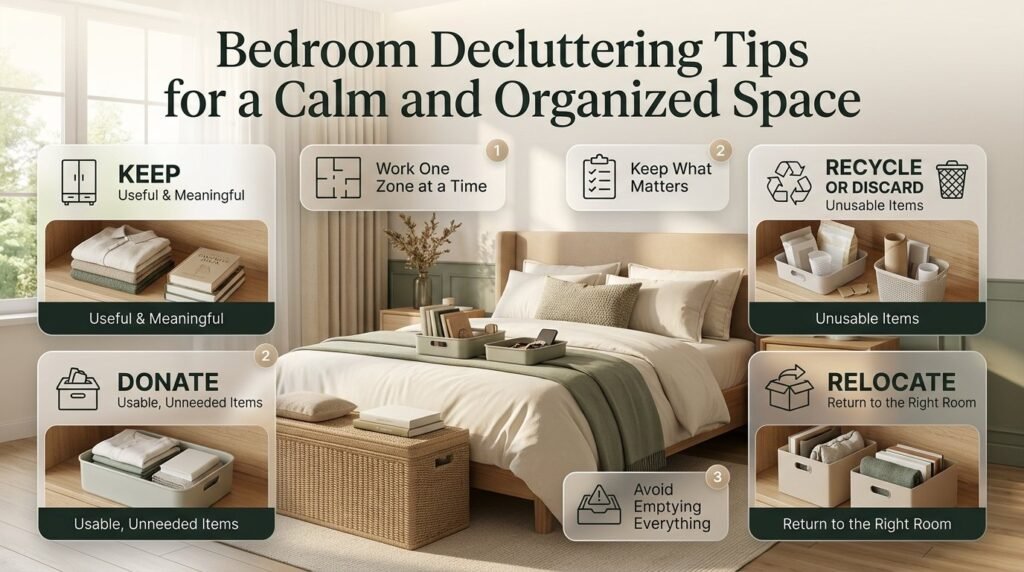
Bedroom decluttering means reviewing your belongings and removing items you no longer need, use, or want to keep. It is an essential first step because storage systems cannot solve a clutter problem when unnecessary possessions occupy the available space.
The goal isn’t to discard everything that isn’t used daily. Instead, identify what deserves space in your bedroom and make sure the belongings you keep are easy to store and access.
Use four categories to sort belongings
| Category | Examples | Recommended action |
|---|---|---|
| Keep | Everyday clothing, useful accessories, favorite books | Return to appropriate storage |
| Donate | Usable items you no longer need | Set aside for donation |
| Recycle or discard | Unusable packaging and damaged items | Dispose of responsibly |
| Relocate | Belongings that belong elsewhere | Move to their proper location |
Start with straightforward decisions. Empty packaging, unwanted paper, and items that clearly belong in another room are generally easier to sort than sentimental possessions.
Once visible clutter has been removed, review clothing and accessories. Ask whether an item fits your current needs, whether you use it, and whether you have an appropriate place to store it.
There is no need to discard meaningful photographs, gifts, or keepsakes simply to achieve a minimalist appearance. A well-organized bedroom can contain personal belongings as long as they have suitable storage.
Declutter according to manageable zones
Instead of treating the bedroom as one enormous project, divide it into smaller sections.
- First session: Bedside tables, visible surfaces, and rubbish.
- Second session: Everyday clothing and laundry.
- Third session: Dresser drawers and accessories.
- Fourth session: Closet shelves and seasonal belongings.
- Fifth session: Books, decorations, and miscellaneous items.
You can complete these sessions on different days or combine them when you have enough time.
How do you decide what to keep?
Consider three questions:
- Does this item serve a current purpose?
- Is it something I genuinely want to keep?
- Does it have a suitable storage location?
If an item is useful or meaningful, make room for it. If it no longer serves a purpose, consider whether it can be donated, recycled, or discarded appropriately.
Common Mistake: Emptying every closet, drawer, and cupboard before deciding what to keep can create a larger mess than you started with. Work in manageable sections so each area can be completed before you move on.
3. What Is the Best Way to Organize a Bedroom Closet?
The most effective closet organization system groups similar clothing together and places frequently used garments where they are easy to reach. When each category has a designated location, getting dressed becomes simpler, returning clean laundry takes less effort, and overcrowded shelves become easier to identify.
Begin by reviewing your clothes and determining how much space each category requires.
Group clothing by purpose
Useful categories include:
- Everyday shirts and tops.
- Trousers, jeans, and skirts.
- Workwear or school clothing.
- Jackets and outerwear.
- Sleepwear and loungewear.
- Occasionwear.
- Seasonal garments.
- Delicate or special-care clothing.
Arrange each category according to your routine. If you wear similar outfits throughout the week, keeping everyday garments together can make getting dressed easier. If you need different clothing for work, school, or other activities, separating those categories may be more useful.
Make better use of hanging space
Closets often contain unused space above hanging garments or between shelves. You can use these areas for lightweight storage boxes, folded clothing, or accessories, provided the arrangement remains safe and accessible.
Useful closet organizers include:
- Slim hangers that reduce wasted hanging space.
- Shelf dividers for folded garments.
- Small baskets for accessories.
- Hanging organizers for suitable lightweight items.
- Labeled containers for seasonal clothing.
Avoid squeezing too many garments onto one rail. Clothes should be easy to remove without pulling other items out of place.
Organize shelves according to accessibility
Keep frequently used items on convenient shelves and move occasional-use belongings to less accessible areas.
For example, everyday T-shirts might belong on a middle shelf, while spare blankets or seasonal accessories can occupy a higher shelf if they can be retrieved safely.
Don’t stack folded clothing so high that the pile becomes unstable. Shorter, manageable stacks are usually easier to maintain.
Should you organize clothes by color or category?
Category-based organization is generally the most practical starting point because it helps you find the type of garment you need. Color organization can be added afterward if it helps you plan outfits.
| Organization method | Best use | Main advantage |
|---|---|---|
| By category | Everyday wardrobes | Makes clothing easier to locate |
| By color | Coordinated wardrobes | Simplifies visual outfit planning |
| By frequency of use | Busy daily routines | Keeps essentials accessible |
| By season | Limited storage space | Reduces crowding from unused garments |
Expert Tip: Combine category and frequency-of-use systems. Keep everyday shirts together, place the garments you wear most often at the front, and arrange them by color if that makes outfit selection easier.
How can you maintain an organized closet?
After laundry is complete, return clothing to its assigned category instead of placing it wherever space happens to be available.
Review your closet periodically, especially when drawers become difficult to close or garments are hard to retrieve. These are signs that the current arrangement may need adjusting.
You do not necessarily need additional storage. Sometimes, moving one category to another shelf or removing unused items can solve the problem.
4. How Can You Organize Bedroom Drawers Efficiently?
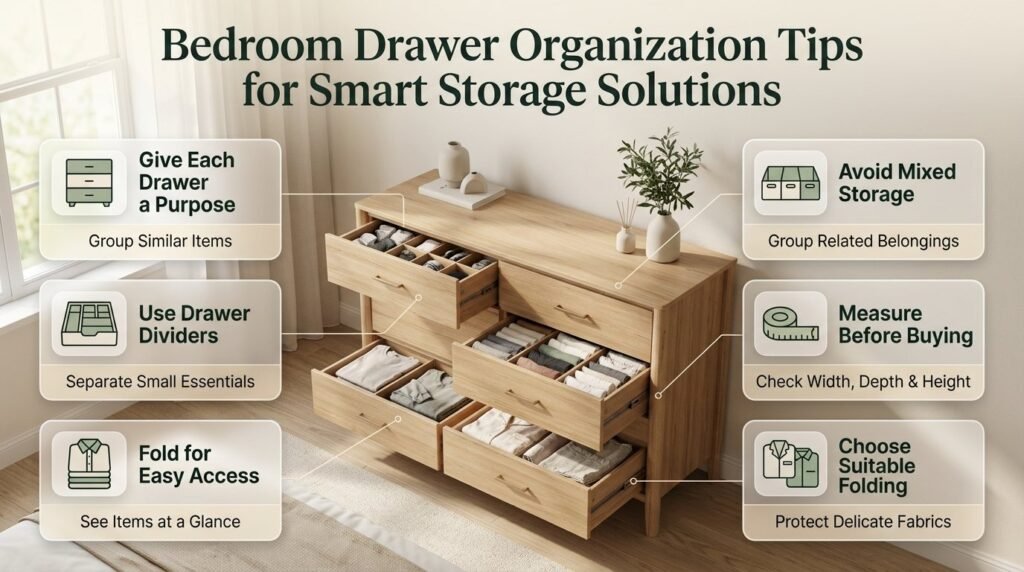
Bedroom drawers become easier to maintain when each one has a clear purpose. Instead of placing miscellaneous belongings wherever there is room, assign specific categories to individual drawers and use dividers where they solve a genuine problem.
This approach prevents small items from mixing together and makes it easier to return belongings after use.
Give each drawer a specific purpose
A dresser might be arranged in the following way:
- Top drawer: Socks, underwear, and small everyday accessories.
- Second drawer: T-shirts and casual tops.
- Third drawer: Sleepwear and loungewear.
- Lower drawer: Seasonal clothing or less frequently used garments.
This is only an example. Your ideal arrangement depends on the size of your dresser, the number of drawers, and the belongings you use most often.
If your dresser has shallow drawers, reserve them for smaller garments and accessories. Larger drawers can accommodate bulkier clothing or grouped storage containers.
Use drawer dividers where they help
Drawer dividers can separate socks, accessories, and other small belongings. Adjustable dividers are useful because their layout can change when your needs change.
For flexible garments such as T-shirts and leggings, try folding them into compact shapes and placing them upright when drawer height permits. This makes more items visible without requiring you to lift an entire stack.
However, vertical folding isn’t suitable for every fabric. Delicate garments, bulky knitwear, and clothing that creases easily may be better stored flat.
Prevent drawers from becoming mixed storage
Avoid placing unrelated items in every available gap. A drawer filled with stationery, clothing, spare cables, receipts, and accessories becomes difficult to maintain because there is no clear system.
Instead, group related belongings together. If you need to store unrelated categories in one drawer, use separate compartments.
Quick Tip: Measure the interior width, depth, and height of a drawer before purchasing organizers. A container that doesn’t fit properly can waste more space than it saves.
5. What Are the Best Bedroom Storage Ideas for Small Spaces?
Small bedrooms benefit from storage solutions that use existing space efficiently, reduce unnecessary furniture, and keep daily essentials accessible. The goal is to make the room functional without obstructing movement or filling every empty corner with containers.
Before buying new storage products, consider what you already own and whether rearranging your belongings could solve the problem.
Use the space under your bed
The area beneath a bed can provide useful storage for belongings that don’t require daily access, provided the bed design offers sufficient clearance.
Suitable items include:
- Extra sheets and pillowcases.
- Out-of-season clothing.
- Spare blankets.
- Travel accessories.
- Lightweight bags and occasional-use items.
Choose containers that fit the available space and can be removed easily. Lidded boxes or zippered fabric bags can help protect stored belongings from dust.
Check under the bed periodically for moisture, dust, or signs of pests. Avoid storing items there if the area is damp or poorly ventilated.
Make better use of vertical space
When floor space is limited, wall-mounted storage can provide additional capacity without requiring another large piece of furniture.
Consider these options:
- Wall shelves for books and lightweight belongings.
- Hooks for bags and frequently used accessories.
- Hanging organizers for small items.
- Compact bedside shelves where a conventional nightstand won’t fit.
Always consider the wall construction, appropriate fixings, and the manufacturer’s weight limits before installing shelves or hooks.
Choose furniture that serves more than one purpose
Furniture with built-in storage can reduce the need for separate pieces.
| Storage solution | Benefit | Consideration |
|---|---|---|
| Storage bed | Provides space beneath the mattress | Check access and ventilation |
| Tall dresser | Uses vertical space | Ensure it fits safely |
| Storage ottoman | Combines seating and storage | Avoid using it as a dumping place |
| Under-bed containers | Uses otherwise empty space | Requires sufficient clearance |
| Wall shelves | Keeps floor space available | Requires suitable installation |
Measure the room before purchasing furniture. Remember to account for drawer openings, wardrobe doors, and walking paths.
Make existing furniture work harder
You don’t always need to purchase specialist organizers. A suitable box, basket, or tray you already own may be enough to group small belongings.
For example, a small box can hold charging cables, a basket can contain accessories, and an existing shelf can provide a designated place for books.
The important thing is to choose storage that fits the belongings and remains easy to access.
For more practical ideas for compact rooms and homes, explore Small Space Home Tips.
6. How Should You Organize Your Bedside Table?
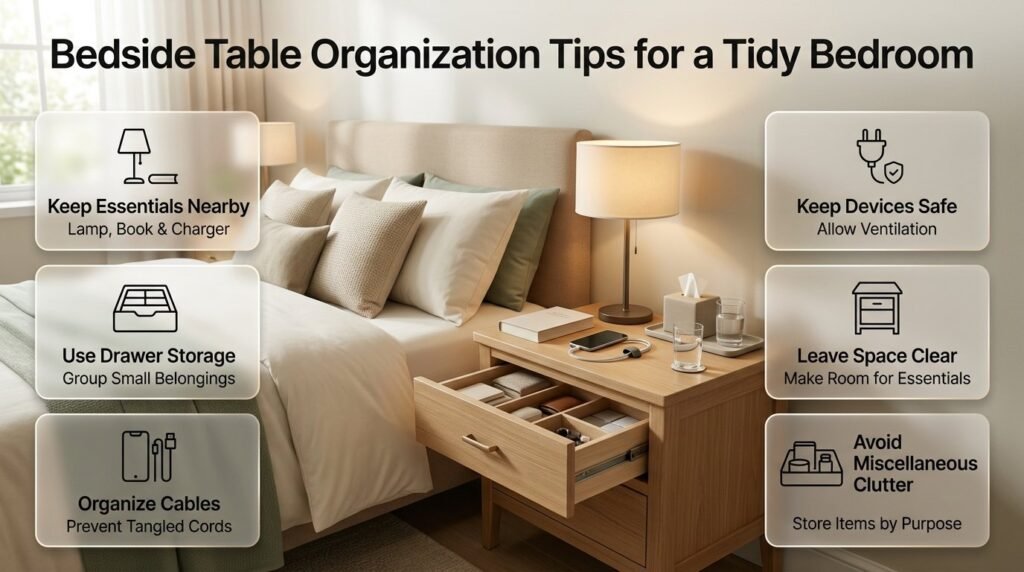
A bedside table should hold the belongings you genuinely use near bedtime or immediately after waking. Keeping its contents limited makes the surface easier to clean and prevents miscellaneous items from accumulating beside your bed.
Keep everyday essentials within reach
Depending on your routine, useful items might include:
- A reading lamp.
- A book or e-reader.
- A phone charger.
- A small tissue box.
- A watch or frequently used accessory.
- A glass of water placed securely.
If your bedside table has drawers, use them for small essentials such as charging cables, stationery, or other suitable belongings.
Avoid turning the table into a general storage surface for receipts, shopping bags, unused cosmetics, and miscellaneous household items.
Keep cables and electronics organized
Loose cables can make an otherwise tidy bedside area look messy. Cable clips, cable organizers, or a small tray can help keep cords together.
Position electrical devices where they have adequate ventilation, and keep chargers away from bedding and other materials that could obstruct ventilation or trap heat. Follow the manufacturer’s charging and electrical safety instructions.
Keep the surface practical
A bedside table doesn’t need to be completely empty. It simply needs enough room to serve its purpose.
If you regularly read before sleeping, a book and a lamp may deserve a permanent place. If you use a phone charger every night, arrange it so the cable doesn’t become tangled with other belongings.
Pro Tip: Leave some empty space on the bedside table. An uncluttered surface is easier to wipe and gives you room for anything you temporarily need.
7. How Can You Keep Clothes and Laundry Under Control?
Clothing is one of the most common sources of recurring bedroom clutter. Clean clothes, dirty laundry, and garments that have been worn once often end up together on a chair or at the foot of the bed.
The solution is to establish separate destinations for each category.
Create three clear clothing destinations
Dirty laundry: Place a hamper somewhere convenient, such as inside the closet or near the area where you change clothes.
Clean clothing: Fold or hang clean garments and return them to storage after washing and drying.
Clothes that can be worn again: Designate a hook or a small section of hanging space for garments that don’t yet need washing.
This third category can be useful for jeans, jackets, and other garments that aren’t necessarily washed after every use.
Make laundry easier to finish
Your laundry system should fit your schedule. You might complete laundry on specific days, fold clothes as soon as they’re dry, or put away a small load each evening.
If putting clothes away feels difficult, simplify the process. Move the hamper closer to where you change, reduce unnecessary folding steps, or make everyday storage more accessible.
The objective is to create a routine that is easy to repeat rather than one that requires constant effort.
Prevent laundry from becoming a permanent pile
Use these practical habits:
- Avoid leaving clean laundry in baskets for several days.
- Return hanging garments directly to the closet.
- Fold everyday clothes using a consistent method.
- Empty the hamper regularly.
- Review clothing categories when drawers become difficult to close.
If clothing continues to collect on a chair, identify why. Perhaps the hamper is too far away, the closet is overcrowded, or the designated place for reusable garments is inconvenient.
Changing the system is often more effective than repeatedly clearing the same pile.
8. How Do You Organize Bedroom Accessories and Personal Items?
Accessories, jewelry, and personal-care products can create considerable clutter because they are small enough to be left on multiple surfaces. Grouping similar belongings together makes them easier to locate and prevents them from spreading throughout the bedroom.
Give jewelry its own storage area
Use small trays, compartment boxes, or suitable hanging organizers to separate necklaces, earrings, bracelets, watches, and other accessories.
Keep frequently worn items in accessible storage. Valuable or delicate pieces should be stored appropriately rather than left exposed on an open dresser.
For necklaces, individual compartments or separate hooks can help prevent tangling. Avoid placing every piece into one container where chains can become intertwined.
Organize personal-care products
If you get ready in your bedroom, create a small station for everyday personal-care products.
A tray can hold frequently used items, while a drawer organizer can store backup supplies. Keep products according to their storage instructions, and avoid overcrowding the surface.
Review products occasionally and dispose of expired or unusable items according to their labels and local disposal guidance.
Manage miscellaneous accessories
Small belongings such as sunglasses, belts, watches, stationery, and electronic accessories are easier to manage when each category has a specific location.
A divided drawer, a small box, or a dedicated shelf may be enough. Choose a storage method based on the quantity and type of items rather than the appearance of the organizer.
Common Mistake: Buying several storage containers before sorting your belongings can create unnecessary clutter. Decide what you need to store first, then select products that fit those items and your available space.
9. How Can Furniture Placement Improve Bedroom Organization?
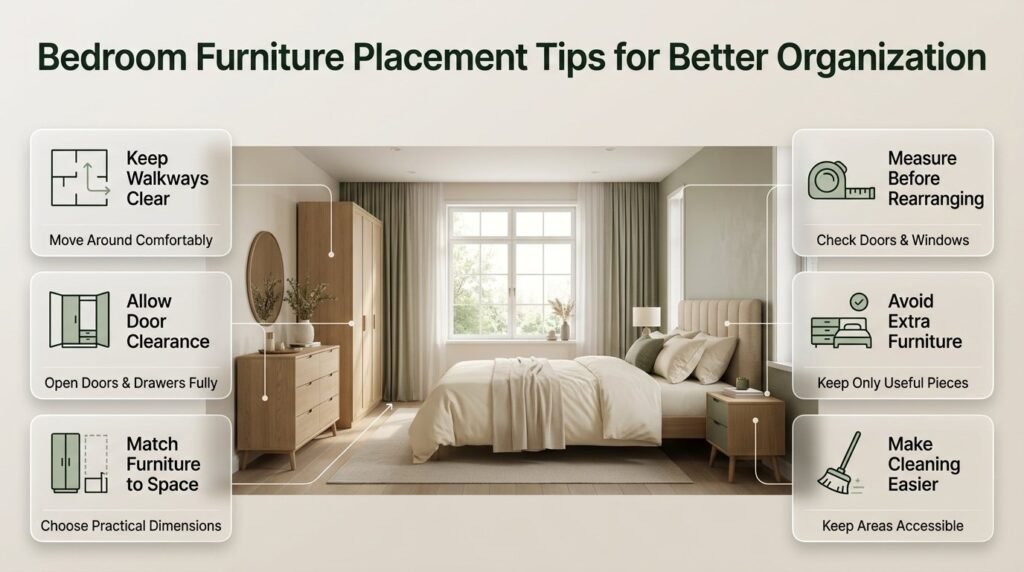
Furniture placement affects how easily you can move around the bedroom, access storage, make the bed, and clean the floor. A practical layout can improve the room without requiring new furniture or expensive changes.
Keep movement and access in mind
Arrange the bed, wardrobe, dresser, and other furniture so the room remains easy to navigate.
Check that you can:
- Walk comfortably between furniture pieces.
- Open closet and dresser doors fully.
- Reach bedside essentials without stretching awkwardly.
- Access windows and necessary room features.
- Clean around furniture when needed.
If a drawer repeatedly hits another piece of furniture, consider repositioning one of the items rather than accepting the inconvenience as normal.
Match furniture to the available space
A large dresser may offer substantial storage but become impractical if it blocks movement. In a small room, a tall and narrow storage unit may be more useful than a wide cabinet.
In a larger bedroom, additional furniture can be practical if it serves a clear purpose. However, adding a chair, table, or cabinet simply because there is room may create more surfaces for clutter to accumulate.
Before rearranging furniture, measure the room and note door swings, electrical outlets, windows, and other features that affect placement.
Avoid unnecessary furniture
A practical bedroom doesn’t need a separate piece of furniture for every category of belongings.
If your existing dresser, closet, and bedside table already provide adequate storage, additional units may make the room harder to navigate. First review how current storage is being used and whether moving items between categories could solve the problem.
Expert Tip: Don’t assume that more furniture means better organization. A smaller number of appropriately sized pieces can be easier to maintain than a room filled with separate storage units.
10. How Should You Organize Bedroom Shelves and Decorative Items?
Bedroom shelves work best when they combine practical storage with a manageable amount of decoration. Filling every shelf completely can make the room feel crowded and create more work when dusting or cleaning.
Group belongings in a practical way
Keep books together, place small accessories in suitable containers, and leave some open space between decorative objects.
For example, a shelf might contain a small book collection, one storage basket, and a few meaningful decorative items. The arrangement can remain personal without becoming difficult to maintain.
Keep frequently used items accessible
Place regularly used books and accessories at convenient heights. Store occasional-use belongings on higher shelves when they can be accessed safely.
Avoid positioning heavy items above the bed or in locations where they could fall. Ensure shelves are securely installed and suitable for the weight they carry.
Balance decoration and function
Decorative objects can make a bedroom feel personal, but they shouldn’t interfere with useful storage.
If you enjoy displaying photographs, keepsakes, or collections, group them thoughtfully instead of spreading them across every surface. You can preserve the room’s character while leaving enough space for everyday activities.
A useful rule is to keep frequently cleaned surfaces relatively simple and reserve designated areas for objects you genuinely enjoy displaying.
Prevent shelves from becoming cluttered again
Review shelf contents when adding new belongings. If a shelf is already full, decide where a new item belongs rather than simply squeezing it into the nearest gap.
This doesn’t mean you must remove something every time you add an object. It means maintaining enough space for items to remain accessible and preventing shelves from becoming difficult to clean.
11. How Can You Organize Bedding and Linen Storage?
Bedding is easy to overlook when organizing a bedroom because spare sheets, pillowcases, blankets, and mattress protectors may be stored in different places. Giving these items a designated location makes changing the bed easier and prevents linen from taking over everyday clothing storage.
Group bedding by purpose
Separate bedding into practical categories:
- Current sheets and pillowcases.
- Spare sheet sets.
- Extra blankets.
- Seasonal bedding.
- Mattress protectors and pillow covers.
Keep items that are used together in the same storage area where possible. For example, store matching sheets and pillowcases as a set so you don’t need to search through several cupboards when changing the bed.
Choose suitable linen storage
If your bedroom has a linen shelf, reserve a section for spare bedding. If space is limited, a suitable under-bed container may work, provided the area is clean and dry.
Make sure bedding is completely dry before storing it. Damp fabric can develop unpleasant odors and may be damaged by prolonged moisture.
Avoid overfilling storage containers. Compressed bedding becomes harder to retrieve, and a container that is too full may be difficult to close properly.
Review linen regularly
Keep the bedding you use most frequently in accessible locations. Less frequently used seasonal items can be placed elsewhere, provided they remain clean and protected.
If your linen storage is consistently overflowing, review how many spare sets you realistically need and whether some items can be stored in another suitable household location.
The objective is to make bedding easy to find and return, not to create a complicated linen management system.
12. What Bedroom Organization Mistakes Should You Avoid?
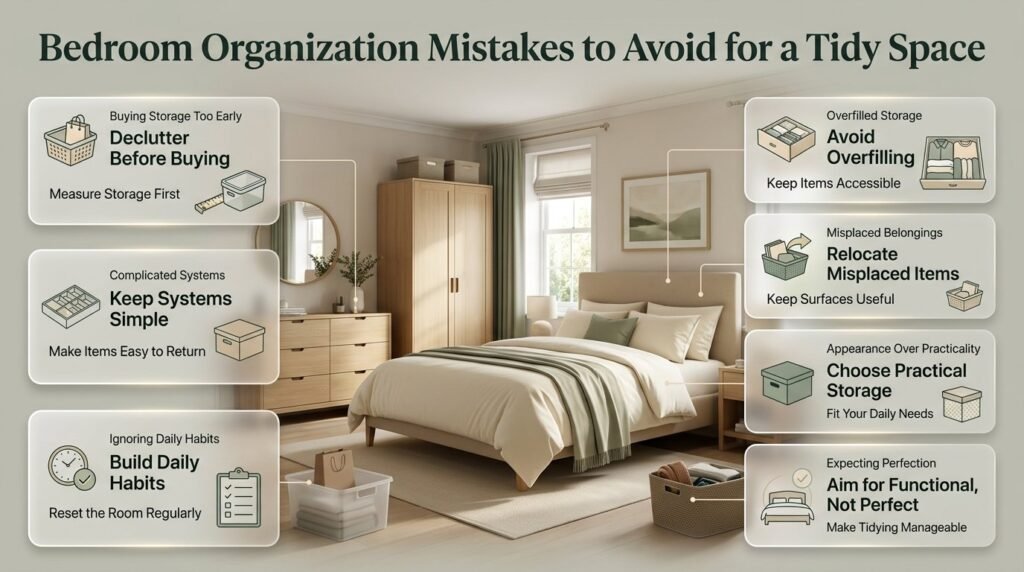
Many organization systems fail because they look attractive but don’t fit the way people actually live. Recognizing common mistakes can help you build a system that remains useful long after the initial cleanup.
Buying storage before decluttering
Why it happens: Containers and organizers appear to offer an immediate solution to a messy room.
Why it causes problems: You may end up storing belongings you don’t need or purchasing products that don’t fit your available space.
How to avoid it: Declutter first, measure storage areas, and buy only what solves a specific problem.
Creating complicated storage systems
Why it happens: Detailed labels, multiple containers, and highly specific categories can appear more organized.
Why it causes problems: Returning an item becomes inconvenient, encouraging belongings to accumulate on visible surfaces.
How to avoid it: Keep categories simple and choose locations that are easy to access.
Ignoring everyday habits
Why it happens: The bedroom is organized during one major session without considering what happens afterward.
Why it causes problems: Laundry, accessories, and miscellaneous belongings gradually return to their previous locations.
How to avoid it: Establish a short daily reset and put items away when you finish using them.
Overfilling closets and drawers
Why it happens: Every available space is used, even when storage has already become difficult to access.
Why it causes problems: Clothes become harder to remove, drawers become disordered, and returning belongings takes longer.
How to avoid it: Leave enough room to retrieve items comfortably and reconsider what belongs in each storage area.
Using the bedroom as a dumping ground
Why it happens: The bedroom becomes a convenient place to leave parcels, shopping bags, paperwork, and items that belong elsewhere.
Why it causes problems: Unrelated belongings occupy useful storage and make surfaces harder to clean.
How to avoid it: Relocate items promptly and use a temporary collection basket only when necessary.
Choosing appearance over practicality
Why it happens: A particular organizing method looks attractive in photographs or seems more sophisticated.
Why it causes problems: The system may not suit the available space or the way you use your belongings.
How to avoid it: Test a simple arrangement before investing in matching containers or replacing furniture.
Trying to maintain everything perfectly
Why it happens: People assume an organized bedroom must remain spotless throughout the day.
Why it causes problems: The expectation can make normal daily mess feel like failure and turn maintenance into an exhausting task.
How to avoid it: Aim for a room that is functional and easy to reset. Temporary mess is normal; a useful system helps you restore order without starting over.
13. What Practical Strategies Make Bedroom Organization Easier?
Effective bedroom organization depends less on expensive products and more on how well a system supports everyday behavior. The best arrangement makes useful actions convenient: clothes have accessible storage, small belongings have clear destinations, and frequently used items remain within reach.
Organize according to frequency of use
Keep everyday clothing, accessories, and personal essentials in easy-to-reach locations. Seasonal items and rarely used belongings can occupy less accessible shelves or suitable storage containers.
This reduces the time spent searching for essentials and prevents frequently used areas from becoming overcrowded.
Store related items together
Keep spare pillowcases with bedding, accessories near the area where you get ready, and everyday reading materials near the bed.
Grouping items according to how you use them reduces unnecessary movement around the room and makes tidying easier.
Design storage around your actual routine
Observe which areas become messy repeatedly. If clothes always accumulate beside the wardrobe, you may need a more convenient hamper or a designated place for garments that can be worn again.
If accessories regularly cover the dresser, a small tray or drawer divider may solve the problem.
Instead of repeatedly reorganizing the same area, identify why clutter returns and adjust the system accordingly.
Use labels only where they help
Labels can be particularly useful for opaque boxes, shared storage, seasonal clothing, and items used infrequently.
Transparent containers can help you identify contents quickly, while closed containers can conceal miscellaneous belongings. Neither option is automatically better; choose according to what you store and how often you need to access it.
Test changes before buying more products
After organizing a zone, use it for a week before making additional purchases.
Notice whether clothes are easy to put away, drawers remain manageable, and frequently used items are accessible. If the arrangement isn’t working, adjust the system before buying something new.
Professional Recommendation: When the same area becomes cluttered repeatedly, treat it as useful information. The storage location may be inconvenient, the category may be too broad, or the available capacity may not match the amount of belongings you keep there.
14. How Can You Maintain an Organized Bedroom Every Day?
A bedroom stays organized when small habits prevent clutter from accumulating. You don’t need to repeat a complete decluttering project every week; a few consistent actions can keep surfaces, closets, and drawers manageable.
Establish a short daily reset
At the end of the day, return misplaced items to their proper locations, put dirty clothes in the hamper, and clear unnecessary objects from visible surfaces.
Make the bed if that helps your morning routine, but remember that a neatly made bed doesn’t replace putting away clothing and personal belongings.
Create a realistic weekly routine
| Frequency | Organization task | Approximate time |
|---|---|---|
| Daily | Return items, manage laundry, clear surfaces | 5–10 minutes |
| Weekly | Dust surfaces, clean floors, review clutter | 15–30 minutes |
| Monthly | Check drawers, accessories, and storage areas | 20–40 minutes |
| Seasonally | Review clothing and rotate seasonal items | As needed |
These are flexible estimates rather than strict requirements. Adjust the routine to suit your room size, household responsibilities, and schedule.
Connect organization with cleaning
Cleaning becomes easier when belongings are already in their proper places. You can wipe surfaces without repeatedly moving miscellaneous items, vacuum the floor without stepping around clothing, and reach furniture corners more easily.
For practical advice on maintaining a cleaner home, Easy Home Cleaning Tips can complement your bedroom organization routine.
Build a routine that suits your schedule
Some people prefer tidying before bed, while others find it easier to reset the room in the morning. Either approach can work.
Choose a time when you can complete a few small tasks consistently. If a routine feels too demanding, reduce the number of steps rather than abandoning the system entirely.
The goal is to make maintaining order feel manageable, not to create another long list of household responsibilities.
15. How Can Smart Organization Habits Help You Manage Your Home?
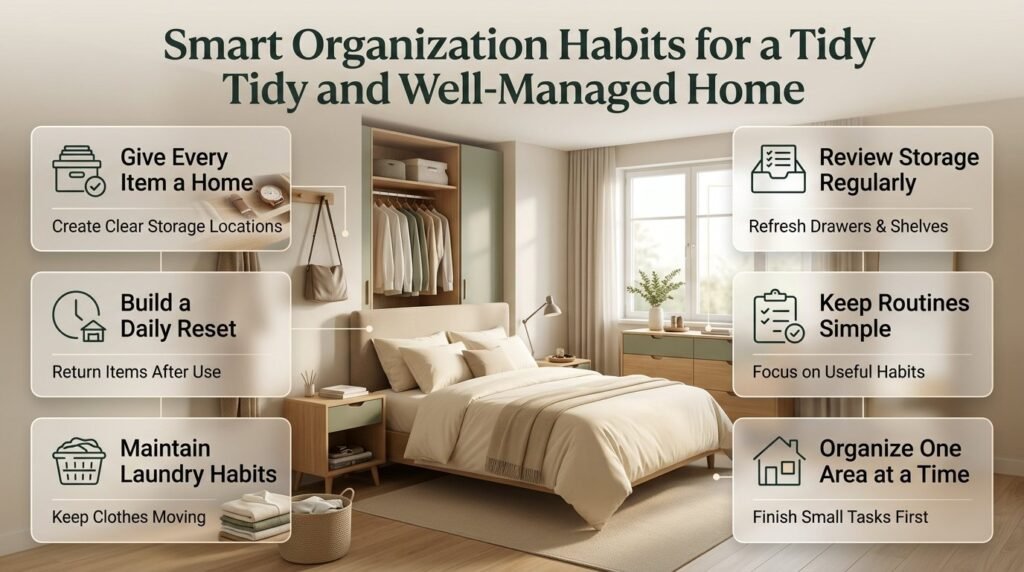
Bedroom organization is part of a wider household routine. When belongings have clear storage locations and everyday tasks are easy to repeat, managing the bedroom can become less time-consuming.
The same principles can be applied to other rooms, but each space has different requirements. A bedroom prioritizes clothing, personal belongings, bedding, and comfort, while a kitchen needs accessible food storage, cooking equipment, and easy-to-clean surfaces.
Create a home for recurring items
Items that regularly enter the bedroom should have a clear destination.
For example, a watch may belong in a bedside drawer, a bag may have a designated hook, and clean laundry may go directly into the closet.
When an item repeatedly appears on the floor or on a chair, ask whether its current storage location is convenient enough.
Keep household routines simple
A useful routine might include a short evening reset, a regular laundry schedule, and a monthly review of drawers or shelves.
Avoid adding unnecessary tasks simply to make the system feel more comprehensive. A practical routine should reduce effort rather than create more work.
Connect organization with broader household systems
If several rooms need attention, focus on one area at a time. Completing a small task, such as organizing a bedroom drawer, can be more productive than starting multiple projects without finishing them.
For related strategies that help you manage belongings throughout your home, visit Smart Home Organization Tips.
16. How Can You Organize a Bedroom on a Budget?
An organized bedroom doesn’t require a large budget. In many cases, decluttering, rearranging existing furniture, and assigning clear storage locations can make a meaningful difference without purchasing anything.
Before spending money, identify the specific problem you want to solve.
Start with the storage you already have
Look at your current closet, dresser, shelves, and bedside table.
Could a drawer be used more effectively? Would moving seasonal clothing to a less accessible shelf free space for everyday garments? Could an existing box keep accessories together?
These changes may solve the problem without requiring new products.
Reuse suitable containers
A clean, sturdy box or basket you already own may be suitable for organizing accessories, small belongings, or selected seasonal items.
Choose containers that fit the space and are appropriate for the contents. Avoid reusing packaging that is damaged, dirty, or unsuitable for the items being stored.
Buy only what solves a real problem
Some products are worth considering when existing storage cannot meet your needs.
For example, a drawer divider may help separate small garments, while a suitable under-bed container may protect seasonal clothing. However, decorative labels and matching containers aren’t necessary for every category.
Use this decision guide before making a purchase:
| Problem | First solution to try | When buying something may help |
|---|---|---|
| Mixed drawer contents | Assign categories | When compartments are still needed |
| Clothes on the floor | Improve laundry placement | When a suitable hamper is missing |
| Crowded closet | Review clothing and rearrange shelves | When existing storage remains insufficient |
| Scattered accessories | Group items in one location | When a divider or tray improves access |
| Limited storage | Reuse available space | When a safe, suitable storage gap remains |
The most cost-effective approach is to solve the storage problem before selecting the product.
What Is the Best Way to Organize a Bedroom and Keep It Clutter-Free?
The best way to organize a bedroom is to create a clear place for every item and arrange the room according to your daily routine. Start by removing belongings you no longer use, then organize your clothes, bedside essentials, accessories, and personal items into practical storage zones. Rather than buying storage products immediately, assess your existing furniture and identify where space is being wasted.
A bedroom becomes easier to maintain when frequently used items are accessible and rarely used belongings are stored out of the way. For more practical ideas, explore these Smart Home Organization Tips to develop a consistent approach to managing household clutter.
Practical tips:
Make your bed each morning to establish a simple daily habit.
Keep frequently used items in easily accessible drawers or containers.
Remove unnecessary objects from the floor and bedside tables.
Spend five to ten minutes each evening returning items to their designated places.
How Can I Organize a Small Bedroom With Limited Storage Space?
Organizing a small bedroom requires making better use of the available space rather than filling it with additional furniture. Begin by identifying underused areas, such as the space beneath the bed, the back of the bedroom door, and the vertical space inside a wardrobe. Storage boxes, drawer dividers, hanging organizers, and compact bedside furniture can help keep belongings accessible without making the room feel crowded.
Choose storage solutions that match the items you own and the dimensions of your bedroom. For example, under-bed containers work well for seasonal clothing and spare bedding, while wall-mounted shelves can hold books and lightweight decorative objects. Avoid adding too many storage units because excessive furniture can make a small bedroom harder to navigate.
Practical tips:
Use under-bed storage for items you do not need every day.
Install suitable shelves to use vertical space efficiently.
Choose furniture with built-in drawers when additional storage is necessary.
Keep walkways and frequently used areas clear.
Follow these Small Space Home Tips for more ideas on making compact rooms functional.
How Often Should You Declutter and Reorganize Your Bedroom?
A bedroom does not need a complete reorganization every week. The most effective approach is to combine small daily habits with regular reviews of clothing, accessories, bedding, and other personal belongings. A brief daily reset prevents clutter from accumulating, while a more detailed monthly or seasonal review helps you identify items that no longer serve a purpose.
The ideal schedule depends on your lifestyle, the size of your bedroom, and how quickly belongings accumulate. A shared bedroom or a room with limited storage may require more frequent attention than a spacious room with well-defined storage areas. Consistency matters more than following a rigid schedule.
Practical tips:
Daily: Return misplaced items, put away clothes, and clear the bedside surface.
Weekly: Review laundry, tidy drawers that receive frequent use, and change bedding as needed.
Monthly: Check wardrobes, accessories, and storage containers for unnecessary items.
Seasonally: Reorganize clothing and bedding according to changing weather and household needs.
A regular cleaning routine also helps maintain the results of decluttering. You can complement your bedroom routine with these Easy Home Cleaning Tips to keep your space tidy and comfortable.
What Bedroom Storage Solutions Work Best for Clothes, Shoes, and Accessories?
The most effective bedroom storage solutions depend on the type of belongings you need to organize and how frequently you use them. Wardrobes and hanging rails are useful for clothes that wrinkle easily, while drawers work well for folded garments, sleepwear, and smaller accessories. Shoes are easier to manage when stored in designated racks, clear boxes, or wardrobe compartments rather than scattered across the floor.
Before choosing new storage products, divide your belongings into categories. This makes it easier to select suitable organizers and prevents you from purchasing containers that do not fit your needs. Labels can be helpful for shared storage or seasonal items, but everyday belongings should remain easy to identify without opening multiple boxes.
Practical tips:
Use drawer dividers to separate socks, undergarments, and accessories.
Arrange hanging clothes by category or frequency of use.
Store shoes in one designated location to keep walkways clear.
Place seasonal clothing in clearly labeled containers.
Keep everyday bags, watches, and other frequently used accessories in accessible spaces.
For a more organized home overall, you can also explore Home Tips & Ideas for practical ways to improve everyday household routines.
How Can I Keep My Bedroom Organized Without Spending a Lot of Money?
You can create an organized bedroom without purchasing expensive furniture or decorative storage systems. The first step is to reduce unnecessary belongings and make better use of the storage options you already have. Existing drawers, shelves, baskets, and suitable containers can often be rearranged to provide more practical storage.
Budget-friendly organization focuses on solving specific problems. If clothes accumulate on a chair, establish a dedicated laundry area. If accessories clutter a bedside table, use a small tray or an existing drawer. If seasonal items occupy valuable wardrobe space, relocate them to a suitable storage area. These small adjustments can improve the room’s functionality without requiring a major makeover.
Practical tips:
Repurpose clean boxes or containers to separate small belongings.
Rearrange existing furniture before purchasing additional storage units.
Use folded clothing and vertical drawer arrangements to improve visibility.
Establish a regular donation or decluttering routine for usable items you no longer need.
Prioritize practical storage solutions before buying decorative accessories.
The goal is not to create a perfectly styled bedroom at any cost. It is to build a manageable system that keeps essential belongings accessible, reduces everyday mess, and makes the room more comfortable to use.
Conclusion
Bedroom organization is not just about keeping a room neat; it is about creating a comfortable, functional space that supports your everyday routine. By decluttering unnecessary belongings, arranging clothes and accessories properly, making better use of available storage, and keeping frequently used items within reach, you can make your bedroom easier to manage without spending a lot of money.
The most effective approach is to start with small, practical changes and maintain them through consistent daily habits. Make your bed, return belongings to their designated places, keep surfaces clear, and review your storage areas regularly. If you have a small bedroom, prioritize vertical storage, multifunctional furniture, and clear walkways to make the most of the available space.
For more inspiration, explore Heartomenal for practical home improvement ideas, organization strategies, and helpful routines. You can also apply ideas from Smart Home Organization Tips to improve how you manage everyday clutter throughout your home.
Ultimately, an organized bedroom does not need to be perfect or expensive. A thoughtful layout, suitable storage, and a few consistent habits can help you maintain a tidy, welcoming environment that feels easier to use and enjoy every day.
Leave a Reply