Introduction
Small Space Home Tips | Living in a small home can be challenging when everyday belongings seem to occupy every available surface. A bedroom may feel crowded because of oversized furniture, a kitchen counter may disappear beneath appliances, and a living room may have little space left for comfortable movement. The good news is that you don’t always need more square footage to solve these problems.
The right small space home tips can help you use your existing rooms more effectively, create practical storage, improve furniture arrangements, and make everyday household tasks easier. Instead of filling every empty corner with another organizer, focus on understanding how you use your space and what makes it difficult to maintain.
This guide from Heartomenal explains practical ways to make a compact home more comfortable, from choosing space-saving furniture to organizing kitchens, bedrooms, bathrooms, and shared living areas. You’ll also learn how to avoid expensive mistakes, improve your layout on a budget, and establish simple habits that keep your home functional over time.
What Are the Best Small Space Home Tips?
The best small space home tips focus on three priorities: using available space efficiently, keeping essential belongings accessible, and maintaining enough open space for comfortable movement. You can achieve these goals by choosing appropriately sized furniture, using vertical storage, reducing unnecessary clutter, and giving everyday items designated places.
Start with the changes that solve your most noticeable problems rather than attempting to redesign the entire home.
- Measure before buying: Check furniture dimensions and the space required to use drawers, doors, and folding components.
- Think vertically: Use suitable wall shelves, hooks, and tall storage units where they improve access.
- Choose furniture carefully: Look for useful features such as built-in drawers, nesting tables, or foldable work surfaces.
- Create functional zones: Give sleeping, working, dining, and relaxing activities clear places.
- Protect open space: Avoid filling every wall, corner, or tabletop with unnecessary items.
- Build simple routines: Return belongings to their designated locations and review crowded areas regularly.
These principles work in small apartments, studio flats, compact houses, and individual rooms with limited storage. The specific solution depends on your floor plan, household needs, and budget.
1. How Can You Make a Small Home Feel Bigger?
A small home can feel more spacious when furniture fits the room, natural light remains unobstructed, and walking routes are easy to follow. Light colors and mirrors can help, but the most important improvements often come from reducing visual congestion and arranging essential furniture thoughtfully.
Keep Walking Paths Open
Begin by identifying the routes you use most frequently. These may include the path from the entrance to the living room, the space between the bed and wardrobe, or the route from the kitchen counter to the refrigerator.
Move furniture that unnecessarily interrupts these routes. Keep shoes, bags, laundry baskets, and loose belongings out of the main pathways.
Example: If a coffee table makes it difficult to walk between the sofa and the entrance, try a smaller table or a nesting design that can be moved when necessary.
The goal isn’t to leave the entire floor empty. It’s to make movement feel natural instead of forcing people to navigate around obstacles.
Use Light Colors Without Limiting Your Style
Soft white, warm cream, pale beige, and light gray can help reflect available light and create a more continuous appearance. These colors are particularly useful in rooms with small windows or limited daylight.
However, a small home doesn’t need to be entirely white. You can introduce navy, forest green, terracotta, or other deeper shades through furniture, cushions, artwork, and accent walls.
For a balanced appearance, choose a main color, a supporting color, and one or two accent shades. Repeating these colors across connected spaces can create visual continuity.
Position Mirrors Thoughtfully
A mirror can make a room feel brighter when it reflects a window or another light source. A full-length mirror near a wardrobe can also serve a practical purpose without requiring a separate dressing area.
Before hanging one, check what it reflects. A mirror facing a crowded shelf may emphasize clutter rather than improve the room’s appearance.
Use secure mounting appropriate for the mirror’s weight, and avoid placing heavy mirrors where they could fall onto a bed or seating area.
Choose Curtains That Suit the Room
Heavy curtains can make a small room feel visually crowded when they cover a large portion of a window. Lightweight curtains may allow more daylight through while still providing privacy.
If the window arrangement permits, mounting the curtain rod slightly above the window frame can create the impression of greater height.
Choose curtain lengths and fabrics according to privacy, sunlight, and cleaning needs rather than appearance alone.
Pro Tip: Before purchasing decorations, remove a few nonessential items and observe how the room feels. You may find that a clearer arrangement makes a bigger difference than adding another decorative feature.
2. Which Furniture Is Best for Small Homes?
Furniture works best in a small home when it fits the available floor area, supports the activities you perform daily, and doesn’t interfere with access to other items. Storage beds, compact sofas, nesting tables, folding desks, and extendable dining tables can be useful when their features solve a genuine space problem.
| Furniture type | Best application | Main benefit | Important consideration |
|---|---|---|---|
| Storage bed | Small bedroom | Stores bedding or clothing | Drawer clearance |
| Nesting tables | Living room | Flexible surface space | Stability |
| Folding desk | Small work area | Can be folded away | Support and wall clearance |
| Storage ottoman | Living room | Combines seating and storage | Usable interior capacity |
| Extendable table | Dining area | Accommodates changing needs | Space when fully extended |
| Narrow bookcase | Small room | Uses vertical space | Stability and anchoring |
| Sofa bed | Guest or multipurpose room | Provides seating and occasional sleeping | Comfort and opening space |
Measure Furniture Before Purchasing
One of the most common small-home mistakes is choosing furniture based on its appearance without checking its dimensions.
A sofa may look compact online but leave little room for a coffee table once it arrives. A storage bed may fit perfectly until you discover that its drawers cannot open because they face a wall.
Before buying furniture, measure:
- The available floor area.
- Doorways, hallways, and other delivery access points.
- The furniture’s full width, height, and depth.
- The space required for doors, drawers, and extendable components.
- The remaining walking space after installation.
You can use removable tape to mark the furniture’s footprint on the floor. This simple test helps you understand how the room will function before you spend money.
Should You Buy Multifunctional Furniture?
Multifunctional furniture is especially useful when one room serves more than one purpose. A desk may double as a dressing table, a dining table may provide a workspace, and a storage bench may offer seating near the entrance.
However, multifunctional furniture isn’t always the best solution.
A folding table can become inconvenient if you need to open it several times every day. A sofa bed may not provide the comfort you want for everyday sleeping. A storage ottoman may be difficult to use if you must remove everything on top whenever you need something inside.
Choose based on your actual routine, not simply the number of functions a product advertises.
When Is Larger Furniture Better Than Several Small Pieces?
A room filled with many tiny furniture pieces can sometimes look more cluttered than a room with one appropriately sized sofa and a single useful table.
Larger furniture can work well when it anchors the room, provides sufficient seating, and reduces the need for several separate items. The key is proportion: the furniture must suit the dimensions of the space and leave comfortable routes around it.
Common Mistake: Don’t assume that every piece of furniture must be miniature. Measure the room, consider its main purpose, and choose the arrangement that provides the best combination of comfort and usable space.
3. How Can You Maximize Vertical Space?
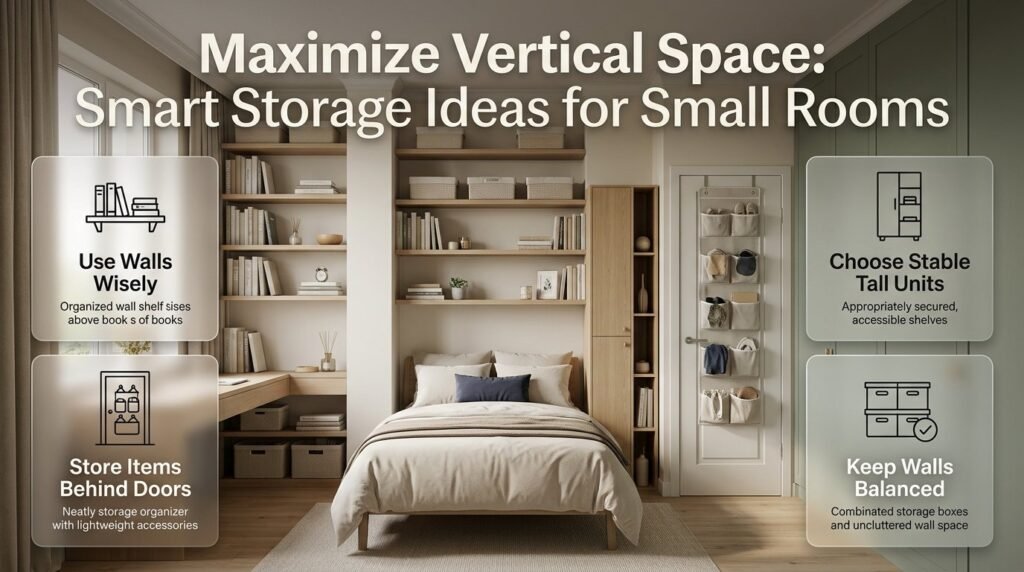
Vertical storage uses walls and available height to reduce dependence on floor-standing furniture. Shelves, wall-mounted cabinets, hooks, and tall bookcases can create useful storage in compact rooms, provided they’re installed safely and don’t make everyday items difficult to reach.
Install Shelves Where They Solve a Problem
Shelves are useful above desks, beside beds, inside suitable storage areas, and on unused wall sections. They can hold books, folded towels, lightweight baskets, and frequently used accessories.
Before installing a shelf, consider three things:
- What items will it hold?
- How much weight will it support?
- Can you reach those items safely?
Use fixings appropriate for the wall material and the shelf’s intended load. Heavy objects should not be stored above beds or seating where a falling item could cause injury.
Make Better Use of Door Space
The backs of doors and the insides of cabinet doors can provide additional storage without occupying much floor area.
Depending on the door and organizer, you might store:
- Coats, bags, or lightweight accessories.
- Bathroom toiletries.
- Small cleaning supplies.
- Kitchen utensils or other lightweight items.
Check the organizer’s weight limits and make sure the door can close properly. Avoid hanging heavy objects where they could make a door unstable or interfere with its movement.
Choose Tall Storage Units Carefully
A tall, narrow cabinet may provide more storage than a wide unit occupying a similar amount of floor space. This can be useful in bedrooms, kitchens, hallways, and utility areas.
However, taller furniture is not automatically better. It needs to be stable and appropriately secured, and its upper shelves should remain accessible without climbing on chairs or unstable furniture.
Avoid Turning Every Wall Into a Storage Area
Vertical storage is helpful, but too many shelves can create visual clutter and increase cleaning work.
Leave some wall areas open. Use closed cabinets for miscellaneous belongings and reserve open shelves for items that are attractive, useful, or easy to keep orderly.
Expert Tip: Plan storage by category rather than by available gaps. Keeping similar belongings together makes them easier to find and helps prevent the same items from spreading throughout the house.
4. How Do You Organize a Small Kitchen?
A small kitchen becomes easier to use when everyday equipment has a convenient place, food preparation surfaces remain available, and cupboards are arranged according to cooking habits. Instead of trying to store everything within arm’s reach, prioritize the items you use most frequently.
Create Practical Kitchen Zones
Even a compact kitchen can have distinct zones for different activities.
Preparation zone: Keep cutting boards, mixing bowls, and frequently used utensils near the main preparation surface.
Cooking zone: Place suitable pots, pans, and cooking tools near the stove without obstructing ventilation or creating heat hazards.
Cleaning zone: Keep dishwashing supplies near the sink, stored safely and separately from food.
Food storage zone: Group pantry staples, containers, and dry ingredients together.
These zones don’t require separate counters. They’re simply a way to make everyday activities more organized.
Use Cupboard Space More Efficiently
Shelf risers can help separate plates or cups, while drawer dividers can prevent utensils from becoming mixed together. Vertical organizers may also make baking trays and cutting boards easier to access.
Before buying any organizer, measure the cupboard’s width, depth, and height. A product that doesn’t fit correctly may reduce usable storage rather than increase it.
Use clear, food-safe containers for suitable pantry items when they improve visibility and fit the available shelves. Label containers when different ingredients could otherwise be confused.
Reduce Countertop Clutter
Kitchen counters need enough space for preparing food, washing dishes, and placing hot or freshly prepared items safely.
Keep frequently used appliances available when they genuinely save time. Store occasional-use equipment elsewhere if doing so is practical.
Avoid stacking appliances or placing items near the stove where heat, moisture, or splashes could create problems.
Use Small Kitchen Accessories Selectively
A magnetic rack, under-shelf holder, or hanging rail can help organize suitable lightweight items. However, adding accessories to every surface may make the kitchen harder to clean.
Choose one solution for a clearly identified problem. If utensils already fit comfortably in a drawer, you may not need a wall-mounted rack.
Quick Example: If mugs take up too much cupboard space, a suitable under-shelf mug holder may free up room. If your real problem is an overcrowded counter, removing an appliance you rarely use may be the better solution.
For broader household ideas, the Home Tips & Ideas guide can complement this article without replacing its specific focus on compact living.
5. How Can You Make a Small Bedroom More Functional?
A functional small bedroom needs comfortable access to the bed, practical clothing storage, suitable lighting, and enough space to move safely. The best layout depends on the room’s shape, window placement, wardrobe position, and whether the bedroom serves additional purposes.
Start With Bed Placement
Because the bed usually occupies a large portion of a bedroom, its position affects almost everything else.
Try different arrangements on paper before moving heavy furniture. In some rooms, placing the bed against a wall creates more floor space. In others, keeping access on both sides may be more practical.
Consider the location of:
- Bedroom doors and wardrobe doors.
- Windows and radiators.
- Electrical outlets and lighting.
- Drawers and other storage furniture.
- The route from the entrance to the bed.
Don’t sacrifice comfortable access simply to fit another piece of furniture.
Make Under-Bed Space Useful
The area beneath a bed can hold seasonal clothing, spare linens, and other belongings that don’t need daily access.
Choose storage containers that fit the available height and can be pulled out without moving the bed. If dust is a concern, lidded containers may be useful.
Avoid storing damp clothing, wet shoes, or items that need regular ventilation in enclosed spaces.
Simplify Bedside Storage
A large bedside cabinet may not be necessary if you only need somewhere for a lamp, book, and phone.
Consider a narrow table, a compact cabinet, or a suitable wall-mounted shelf. Keep essential items accessible and avoid using the bedside area as a general dumping ground.
Make sure lamps and charging equipment are positioned safely, with cables arranged to avoid trip hazards.
Organize Clothing According to Your Routine
Store everyday clothing in the most accessible parts of the wardrobe. Keep occasional-use and seasonal items in other suitable areas.
Drawer dividers can help separate socks, accessories, and smaller belongings. Matching hangers may make a wardrobe easier to navigate, but they won’t solve overcrowding if there are simply too many items for the available space.
Review clothing periodically and remove items that no longer serve a purpose.
What If the Bedroom Also Needs to Be a Workspace?
If you work or study in your bedroom, give the desk a clearly defined place. A compact desk beside a window may work well if it doesn’t obstruct the bed or wardrobe.
Use a small container or drawer for work supplies so that the desk can be cleared when the workday ends. This helps the bedroom return to its primary purpose: rest and comfort.
Pro Tip: Before buying a new bedside table or desk, try removing one nonessential furniture item temporarily. A few days of testing can reveal whether you genuinely need more furniture or simply a better layout.
6. How Can You Organize a Small Living Room?
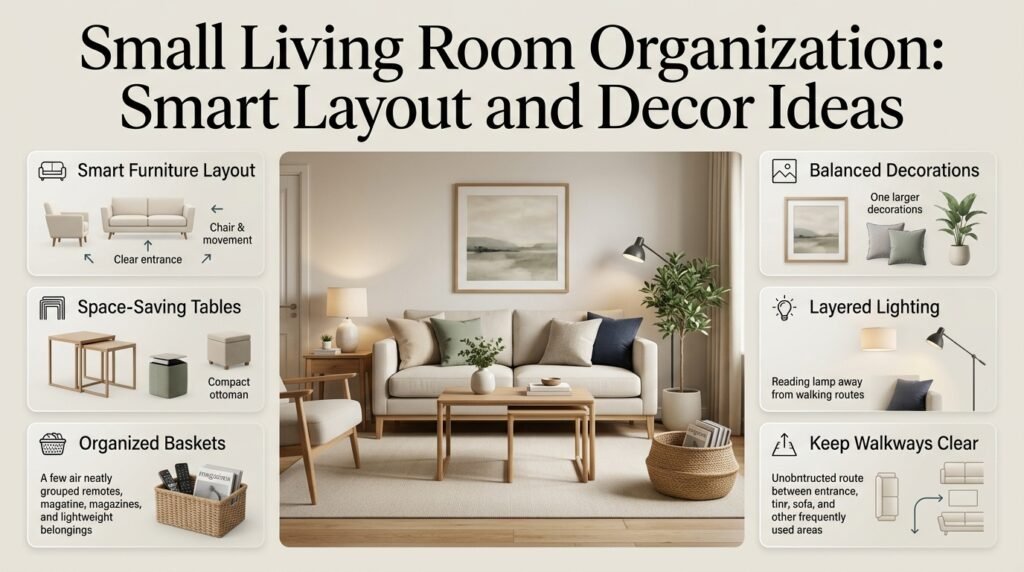
A small living room works best when the main seating arrangement supports conversation, movement remains comfortable, and storage doesn’t dominate the room. You can improve its functionality through furniture placement, compact tables, useful baskets, and a clear focal point.
Arrange Furniture Around the Main Activity
First decide how you use the living room. Is it mainly for watching television, talking with family, reading, or hosting visitors?
Position the sofa and chairs to support that activity. Avoid placing furniture in positions that block the entrance or make it difficult to reach windows and other important features.
In some layouts, placing the sofa against a wall creates more open floor space. In others, moving it slightly away from the wall can improve circulation or define a separate area.
Choose a Practical Coffee Table
A coffee table should provide a useful surface without interfering with movement.
Nesting tables can be separated when additional surface space is needed and stacked when they’re not. A storage ottoman may provide seating and a place for blankets or other lightweight belongings.
If you rarely use a central table, a small side table may be sufficient.
Use Baskets for Shared Belongings
A basket can hold remote controls, magazines, children’s toys, or other small items that are used in the living room.
Choose a size that suits the belongings you intend to store. An oversized basket can become a new source of clutter if people use it to collect anything that doesn’t have a proper place.
Empty and reset the basket regularly rather than allowing it to become a permanent miscellaneous storage area.
Keep Decorations Balanced
A living room can have personality without displaying every decorative object you own.
Choose a few meaningful accessories, such as artwork, cushions, or a plant suitable for the room’s lighting. Leave enough space between objects so that the main features remain visible.
A single larger artwork may create a clearer focal point than many small pieces scattered across every wall.
Improve Lighting in Layers
Use the lighting you need for different activities. General room lighting provides overall visibility, while a reading lamp or task light supports specific activities.
Avoid placing lamps where cables cross walking routes. Make sure the light is comfortable for the room’s purpose rather than relying on one harsh overhead source.
Practical Tip: If your living room feels crowded, temporarily remove a side table or decorative chair. Evaluate the room for several days before deciding whether to bring it back.
7. How Can You Create Separate Zones in a Studio Apartment?
A studio apartment can support sleeping, working, dining, and relaxing without permanent walls. The most effective approach is to establish visual and functional boundaries using furniture, rugs, lighting, and storage while preserving natural light and safe pathways.
Use Furniture to Define Areas
A sofa can distinguish a lounge area from a dining space. A bookcase may create a partial divider, while a desk against a wall can establish a dedicated work area.
Keep furniture dividers appropriately sized. A tall, bulky unit placed in the wrong position can make a studio feel divided into several cramped spaces.
Use Rugs to Identify Functional Zones
A rug can help distinguish a seating area from a workspace or dining area. Choose a size that works with the furniture arrangement and doesn’t obstruct doors.
You don’t need a different rug for every activity. Too many separate floor coverings can make the room feel fragmented.
Give Each Activity Its Own Storage
Shared rooms become difficult to maintain when work supplies, blankets, dining accessories, and personal belongings all compete for the same surfaces.
Use a drawer, basket, or small cabinet for each major category. For example, keep work equipment together so it can be put away after studying or working.
This makes it easier to change the room’s purpose without rearranging everything.
Consider Privacy and Noise
A visual divider doesn’t provide the same privacy or sound control as a wall. If your sleeping area is near a television or work desk, consider where lights and noise will travel.
Position the bed away from busy pathways when possible, and use suitable lighting that can be controlled independently in different areas.
Common Mistake: Trying to create too many separate zones. A studio may only need a sleeping area, a flexible living area, and a compact work or dining surface. Keep the arrangement simple enough to use every day.
8. How Can You Make a Small Bathroom More Organized?
A small bathroom is easier to maintain when toiletries are grouped by purpose, everyday products remain accessible, and the sink and floor aren’t used as overflow storage. You can often improve the layout with drawer dividers, suitable wall storage, and a few changes to what you keep in the room.
Use the Space Beneath the Sink
The area beneath a bathroom sink can hold toiletries, spare toilet paper, and suitable cleaning supplies. However, pipes and plumbing fixtures reduce the available space, so measure the area before purchasing organizers.
Use containers that can be removed easily when you need to access the plumbing. Keep products upright and separate cleaning chemicals from personal-care items.
Check for leaks regularly. Don’t store products in an area where water damage could go unnoticed.
Use Wall and Door Storage
Hooks can hold towels or robes, while suitable shelves can store lightweight toiletries. An over-door organizer may be useful when the door can close properly with it installed.
Keep frequently used products at a comfortable height. Items used by children or other household members should be accessible without requiring unsafe climbing.
Keep the Shower Area Simple
Use a suitable shower caddy for products you use regularly. Avoid storing excessive bottles around the edge of the bathtub or on narrow surfaces where they can fall.
Choose materials designed for damp environments and allow the area to dry properly. Good ventilation is important because crowded, poorly ventilated spaces can retain moisture.
Remove Duplicate and Expired Products
Bathrooms often accumulate partly used toiletries, duplicate products, and items that are rarely used.
Review these supplies periodically. Keep products that are suitable for continued use, dispose of expired items according to their labels, and avoid buying replacements until you know what you already have.
Quick Tip: A small tray can keep daily toiletries together on a vanity, making the surface easier to clear when you need to clean it.
9. How Can You Improve Storage in a Small Entryway?
An entryway becomes more functional when shoes, bags, keys, and outerwear have designated places close to the door. The goal is to prevent everyday belongings from spreading into the living room while keeping the entrance clear and easy to use.
Create a Simple Drop Zone
A drop zone is a designated place for belongings that you bring home or need when leaving.
Depending on the available space, it might include:
- A small tray for keys.
- A few suitable hooks for bags or coats.
- A compact shoe rack.
- A narrow bench, if there is enough room.
- A small container for mail that needs attention.
You don’t need every item on this list. Choose only the features that solve a real problem in your entryway.
Choose Shoe Storage According to Your Household
If only a few pairs of shoes are used daily, a small rack may be sufficient. A larger household may need a cabinet or a clearly defined place for each person’s footwear.
Avoid storing wet shoes in a closed space without allowing them to dry first. Keep the entrance clear enough for people to enter and leave safely.
Make the Most of a Narrow Hallway
In a narrow hallway, prioritize shallow storage that doesn’t reduce walking space. Wall-mounted hooks may work better than a deep cabinet, provided the wall can support the installation.
Measure the hallway before buying furniture, and check that doors can open fully.
Expert Tip: Store frequently used belongings near the entrance and occasional-use items elsewhere. This reduces the number of objects that accumulate beside the door.
10. How Can You Organize a Small Home Office?
A small home office needs a reliable work surface, comfortable seating, adequate lighting, and organized equipment. Even a compact corner can work well when the desk is sized appropriately and work supplies have designated storage.
Select a Desk That Fits Your Work
A narrow desk may be suitable for a laptop and notebook, while tasks involving multiple screens or paperwork may require a larger surface.
Before buying, consider:
- The equipment you use daily.
- The depth needed for comfortable working.
- Space for a chair and safe movement.
- Access to electrical outlets.
- Whether the desk will be used for another activity.
Don’t sacrifice basic comfort simply to fit the smallest possible desk into the room.
Use Vertical Storage for Work Supplies
A suitable shelf or wall organizer can hold notebooks, reference materials, and lightweight supplies. Keep essential items within easy reach and store less frequently used materials elsewhere.
Secure shelves appropriately and avoid placing heavy objects where they could fall onto the desk.
Keep Cables and Devices Organized
Use suitable cable clips or a cable-management box to reduce loose wires. Keep cables away from walking routes and follow the equipment manufacturer’s guidance for ventilation and charging.
Avoid overloading electrical outlets or using extension leads in ways that create safety risks.
Make It Easy to Pack Work Away
If the desk is in a bedroom or living room, a small drawer or container can hold work supplies when the day ends.
This allows the room to return to its other purpose without requiring a complete rearrangement.
Practical Example: If you work at the dining table, keep your laptop accessories and paperwork in one portable container. When work is finished, move the container to its designated storage location and clear the table for meals.
11. How Can You Reduce Clutter Without Giving Up Everything You Own?
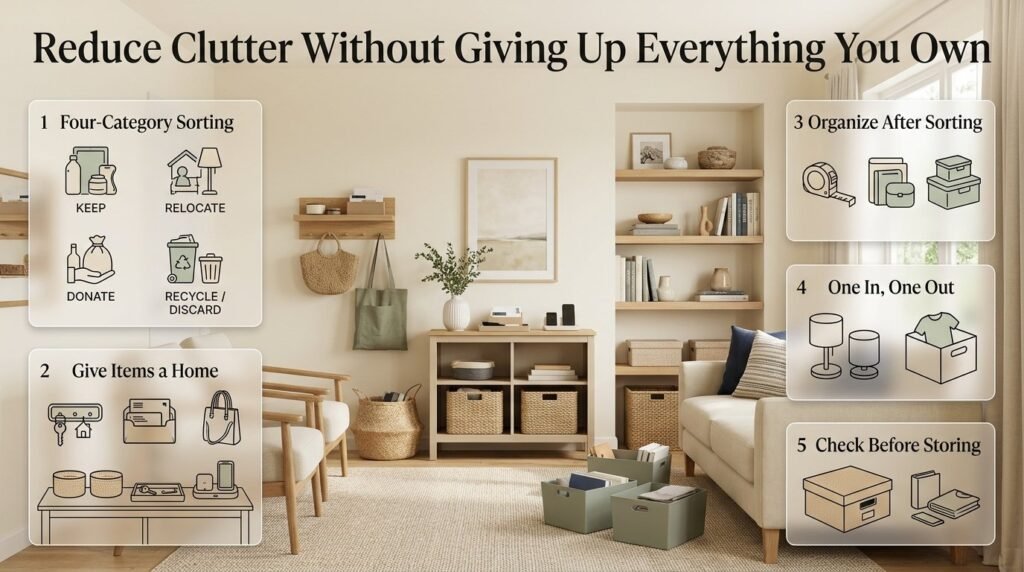
Reducing clutter means making your belongings easier to use and maintain, not removing everything that makes a home personal. The best approach is to identify what you need, give those items suitable storage, and make deliberate decisions about things that no longer serve a purpose.
Use a Four-Category Sorting Method
When organizing a cupboard, drawer, or shelf, separate items into four groups:
- Keep: Belongings you use regularly or genuinely need.
- Relocate: Items that belong in another room.
- Donate or give away: Usable belongings you no longer need.
- Recycle or discard: Items that cannot reasonably be reused, following local disposal guidance.
Work on one small area at a time. Emptying the entire home at once can create a larger mess and make the task difficult to finish.
Give Everyday Items a Permanent Home
Keys, chargers, bags, shoes, and mail frequently create clutter because they lack convenient storage locations.
Choose a designated place near where each item is used. A tray near the entrance, a basket for frequently used accessories, or a charging station can prevent objects from spreading across several surfaces.
The location should be practical enough that household members can maintain the system without extra effort.
Avoid Buying Organizers Too Early
Storage containers can be useful, but they don’t solve the problem of owning more belongings than your available storage can accommodate.
Sort your belongings first. Then measure the space and choose organizers that fit the items you intend to keep.
Clear containers may help when you need to see their contents, while opaque containers can create a calmer appearance for items that don’t need to be visible. Use labels when they genuinely improve access.
Try a One-In, One-Out Habit
When you purchase a new item in a category that already has limited space, consider whether an older item can be donated or removed.
This can be useful for clothing, decorative accessories, mugs, and small household tools. It isn’t necessary for every purchase, particularly essential supplies, but it helps prevent collections from growing without a plan.
Common Mistake: Organizing belongings into attractive boxes without reviewing what they contain. The result may look tidier at first, but the same storage problems return if the underlying clutter remains.
For additional organization strategies, read Smart Home Organization Tips. That guide can support a broader organizing routine, while this article focuses on using limited home space more effectively.
12. How Can You Make a Small Home Easier to Clean?
A compact home is easier to clean when surfaces are accessible, belongings have designated storage, and the cleaning routine is simple enough to repeat. You don’t need to keep every surface empty; you need to reduce the amount of unnecessary moving, sorting, and searching involved in everyday cleaning.
Clear Surfaces Before Cleaning
Move loose items into their designated places before wiping counters or tables. This prevents you from repeatedly cleaning around the same objects.
Use trays or small containers for items that genuinely need to remain accessible. When you need to clean, you can move the group together rather than handling every item separately.
Store Cleaning Supplies Conveniently
Keep suitable cleaning tools near the areas where they’re used, provided they’re stored safely. For example, bathroom supplies can remain in an appropriate bathroom cabinet, while kitchen cleaning cloths can be stored near the cleaning zone.
Always follow product labels, avoid mixing cleaning chemicals, and keep products away from children and pets.
Build a Short Daily Reset
A daily reset might include returning belongings, clearing the kitchen counter, putting away laundry, and checking the entrance for misplaced shoes or bags.
Keep the routine realistic. A short, repeatable process is more useful than a complicated schedule that becomes difficult to maintain.
For more detailed cleaning routines and practical household advice, visit Easy Home Cleaning Tips.
Keep Floors Accessible
Avoid storing unnecessary objects on the floor. Baskets, shoes, and laundry can make vacuuming or mopping more difficult when they remain scattered across a room.
Choose storage that can be accessed without moving several other items first.
Pro Tip: When choosing between two organizing systems, prefer the one that makes putting items away easier. A practical system is more likely to last than one that only looks good immediately after organizing.
13. How Can You Improve a Small Home on a Limited Budget?
You can make a small home more functional without replacing every piece of furniture or purchasing expensive storage systems. Begin with free changes, such as rearranging furniture and sorting belongings, then spend money only when a specific problem remains.
Start With Free Improvements
Before shopping, try these changes:
- Move furniture to improve walking routes.
- Remove unused objects from counters and shelves.
- Rearrange cupboards so frequently used items are easier to reach.
- Repurpose sturdy containers you already own.
- Use existing lamps to improve lighting in work or reading areas.
- Move occasional-use belongings to suitable secondary storage.
These changes may reveal that you need fewer new products than you originally expected.
Choose Low-Cost Storage Carefully
If additional storage is genuinely necessary, consider drawer dividers, suitable hooks, compact baskets, and stackable containers.
Compare the product’s usable capacity, durability, and dimensions rather than choosing solely by price. A cheap organizer that breaks quickly or doesn’t fit the space may cost more in the long run.
Buy Furniture That Solves a Specific Problem
Before buying a storage bed, folding desk, or compact cabinet, identify the exact issue it will solve.
For example, a storage bed makes sense if spare bedding has no suitable home. It may be unnecessary if the real problem is that the wardrobe contains items you no longer use.
Budget Rule: Rearrange first, declutter second, measure third, and shop last.
14. How Can Renters Maximize Space Without Permanent Changes?
Renters can often improve storage through furniture arrangement, freestanding shelving, suitable over-door organizers, and removable products designed for the relevant surfaces. The best approach is to check the rental agreement and product limitations before installing anything that could damage walls, doors, or fixtures.
Use Freestanding Storage
A narrow bookcase, compact drawer unit, or rolling cart may add useful storage without drilling into walls.
Check the footprint carefully and choose stable furniture that doesn’t obstruct doors or windows. Tall units may still require anchoring for safety, so consider the property rules and obtain permission where necessary.
Try Removable Products With Care
Removable hooks and adhesive organizers can be useful for lightweight items when they’re compatible with the surface.
However, removable doesn’t always mean damage-free. Heat, moisture, wall texture, paint condition, and weight can affect performance.
Follow the manufacturer’s installation and removal instructions. Don’t use adhesive products to support heavy objects or anything that could injure someone if it falls.
Use Flexible Furniture
A folding table, movable trolley, or nesting table can adapt to changing needs without requiring permanent alterations.
These options are particularly helpful when one room serves several purposes. Store movable items in a designated place when they’re not in use so that flexibility doesn’t turn into clutter.
Keep the Property’s Original Features Accessible
Don’t block ventilation, electrical panels, windows, or emergency exits to create additional storage. Avoid making changes to fixtures without appropriate permission.
A renter-friendly layout should improve daily convenience while respecting the property’s condition and safety requirements.
15. What Are the Most Common Small-Space Decorating Mistakes?
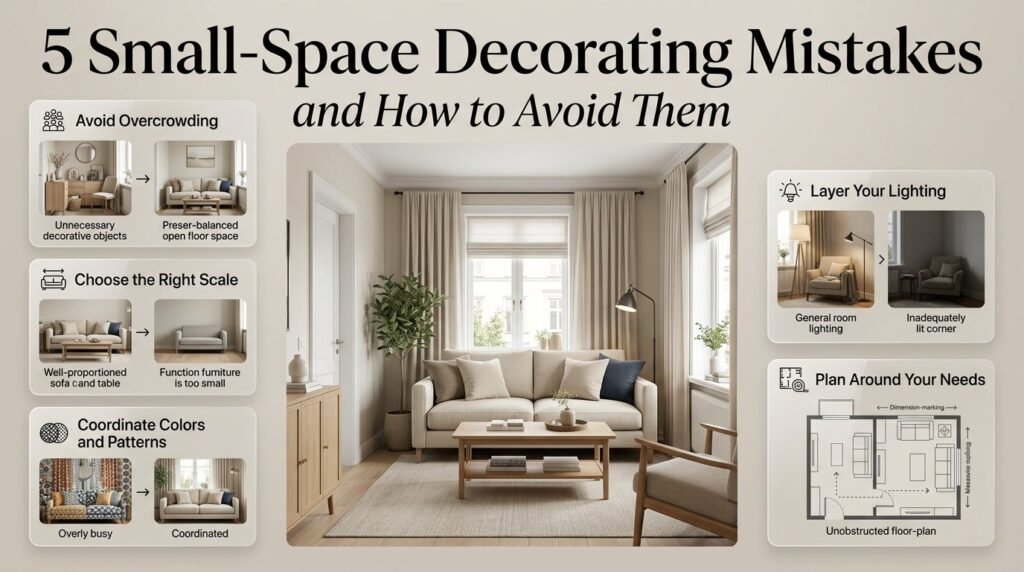
Decorating a small home becomes easier when you balance style with function. The aim isn’t to remove personality from a room, but to ensure that decorations, furniture, and storage work together instead of competing for attention.
Mistake 1: Filling Every Empty Corner
Why it happens: Empty space can feel unfinished when you’re decorating a room.
Why it causes problems: Additional furniture and accessories may block movement and create more surfaces to clean.
How to avoid it: Leave useful gaps around furniture. Add an item only when it improves comfort, storage, lighting, or the room’s appearance.
Mistake 2: Choosing Furniture That Is Too Small
Why it happens: People assume that several small pieces will automatically make a room feel larger.
Why it causes problems: The room can look fragmented, and small furniture may not provide enough seating or storage.
How to avoid it: Choose furniture according to the room’s proportions. A well-sized sofa and one functional table may work better than several small, disconnected pieces.
Mistake 3: Using Too Many Patterns and Colors
Why it happens: Different colors and patterns can look attractive individually.
Why it causes problems: When every surface introduces a new visual element, the room can feel busy.
How to avoid it: Establish a consistent palette and repeat a few colors across textiles, furniture, and accessories. Add contrasting colors deliberately rather than using them everywhere.
Mistake 4: Ignoring Lighting
Why it happens: Furniture and storage often receive more attention than lighting.
Why it causes problems: Dark corners can make rooms feel less inviting, and inadequate task lighting can make everyday activities uncomfortable.
How to avoid it: Combine suitable general lighting with task lighting for reading, cooking, or working. Keep windows unobstructed where possible and choose lighting that suits each activity.
Mistake 5: Copying a Room Layout Without Considering Your Needs
Why it happens: A photograph or design example looks appealing.
Why it causes problems: The layout may depend on different dimensions, window locations, or household routines.
How to avoid it: Treat inspiration as a starting point. Adapt the ideas to your room measurements, storage needs, and daily activities.
16. What Do Home Organization Professionals Recommend?
A practical small-home plan begins by observing how a room is used, identifying the main problem, and choosing a solution that can be maintained. The most useful improvements aren’t necessarily the most expensive; they are the ones that reduce everyday frustration without introducing new difficulties.
Follow the Problem-Solution Method
Instead of setting a broad goal such as “make the house organized,” identify one specific issue.
For example:
| Problem | Possible solution | How to evaluate it |
|---|---|---|
| Shoes collect near the entrance | Designated shoe storage | Is the entrance easier to use? |
| Kitchen counters are crowded | Relocate occasional-use appliances | Is preparation space available? |
| Clothing is difficult to find | Reorganize wardrobe categories | Can you locate everyday items quickly? |
| Desk occupies the living room | Consider a folding or compact desk | Can the room serve both purposes? |
| Spare bedding fills the closet | Assess suitable under-bed storage | Is the bedding accessible and protected? |
This approach helps you spend time and money where they can make a meaningful difference.
Observe the Room Before Making Major Changes
Live with a room long enough to understand how you naturally use it. Notice where you leave belongings, which cupboards are difficult to reach, and where movement becomes awkward.
These patterns often reveal the real issue. If mail always collects near the entrance, a designated drop zone may help more than a new cabinet in the living room.
Make Storage Easy to Maintain
Keep everyday items close to where they’re used and avoid systems that require several steps to put belongings away.
A storage solution should fit your household’s habits. A beautifully arranged shelf is less useful if nobody can maintain it comfortably.
Review Your Progress
After making a change, evaluate whether it solves the original problem. If a new organizer makes a cupboard harder to use, adjust the arrangement rather than buying another product immediately.
For more general home inspiration and practical living ideas, return to Heartomenal, where you can explore other home-related topics beyond small-space layouts.
What Are the Best Small Space Home Tips for Making a Small House Look Bigger?
The most effective small space home tips focus on improving the layout, reducing visual clutter, and making better use of natural light. You don’t need to remove all your furniture or decorate every room in white. Instead, choose furniture that fits the available space, maintain clear walking paths, and use a consistent color palette to create a more connected appearance.
Mirrors can help reflect natural light, while curtains mounted slightly higher than the window can create a sense of height. Keeping floors and countertops reasonably clear also helps rooms feel less crowded.
Practical tips to follow:
Choose furniture according to your room’s dimensions rather than appearance alone.
Use light, coordinated colors while retaining accents that reflect your personal style.
Keep doorways and main walking routes free from unnecessary obstacles.
Avoid filling every empty corner with decorative accessories or storage units.
The key is to make the available space feel open and functional without sacrificing everyday comfort.
How Can I Maximize Storage in a Small Home Without Spending Too Much Money?
Maximizing storage starts with using the space you already have. Before purchasing new organizers or furniture, review your belongings, rearrange existing storage, and identify areas that aren’t being used effectively. Under-bed spaces, suitable wall sections, cupboard interiors, and the backs of doors may offer practical storage opportunities.
Affordable solutions such as drawer dividers, sturdy baskets, suitable hooks, and stackable containers can help when they fit your needs. However, buying storage products before decluttering can create additional expenses without solving the underlying problem.
Budget-friendly strategies:
Reorganize cupboards according to how frequently you use their contents.
Store seasonal belongings separately from everyday essentials.
Use suitable vertical storage to reduce dependence on floor-standing furniture.
Measure cupboards and shelves before buying containers.
Repurpose sturdy items you already own when they’re appropriate for storage.
A well-organized small home doesn’t require expensive products. It requires a clear plan that makes belongings easy to locate, use, and put away.
Which Furniture Is Best for Small Homes and Small Apartments?
The best furniture for a small home combines appropriate dimensions with useful functionality. Storage beds, nesting tables, folding desks, extendable dining tables, and storage ottomans can help maximize available space. The right choice depends on the room’s layout, your household’s needs, and how frequently you’ll use each feature.
For example, a folding desk may work well in a studio apartment where a permanent office would occupy too much space. A bed with drawers may be more useful in a bedroom with limited wardrobe capacity. In a living room, nesting tables can provide additional surfaces when needed without permanently occupying the same area.
Before purchasing furniture, consider:
The furniture’s full dimensions and the space needed to use it.
Whether drawers, doors, or folding components can open comfortably.
The item’s durability, stability, and everyday comfort.
Whether one multifunctional piece can replace several unnecessary items.
The remaining space available for safe and convenient movement.
Remember that multifunctional furniture is valuable only when its features genuinely support your routine. A simpler piece that is comfortable and easy to use may be a better investment.
How Can I Keep a Small Home Clean, Organized, and Clutter-Free?
Keeping a small home organized is easier when everyday belongings have designated storage locations and cleaning doesn’t require moving numerous objects. Instead of waiting until clutter becomes overwhelming, establish small routines that prevent belongings from accumulating on countertops, floors, and furniture.
Start by organizing one area at a time. Give frequently used items convenient storage locations, keep cleaning supplies safely accessible, and return belongings to their proper places after use. These habits make it easier to maintain an organized home without spending hours reorganizing every week.
Simple habits that make a difference:
Spend a few minutes returning misplaced items to their designated locations.
Clear kitchen counters after food preparation.
Put away clean laundry instead of allowing it to accumulate.
Keep shoes, bags, and other everyday belongings organized near the entrance.
Review crowded drawers and shelves regularly.
Follow a realistic weekly cleaning and organization routine.
The most sustainable system is one that fits your lifestyle. Simple, repeatable habits are generally more effective than complicated organizing methods that are difficult to maintain.
How Can I Decorate a Small Home Stylishly Without Making It Feel Crowded?
A stylish small home balances personal expression with practical use of space. You can create an attractive interior with coordinated colors, suitable lighting, appropriately sized furniture, and a few meaningful decorative pieces. The goal isn’t to remove personality but to avoid making every surface compete for attention.
Begin with a simple color palette that works with your existing furniture and natural lighting. Introduce interest through cushions, artwork, textiles, plants suitable for the room, or a distinctive lamp. Mirrors can help reflect light, while rugs can define functional areas in open-plan spaces.
Professional decorating recommendations:
Choose a consistent palette and repeat selected colors throughout connected rooms.
Use a few purposeful decorations rather than covering every shelf.
Select rugs that suit the furniture arrangement and room dimensions.
Combine general lighting with task lighting for reading, cooking, or working.
Leave enough open wall and floor space to maintain visual balance.
Prioritize comfort and functionality over copying a design that may not suit your layout.
A small home can have just as much character as a larger one. Thoughtful choices help create a space that feels personal, comfortable, and easy to maintain.
Conclusion
Making the most of a small home does not require expensive renovations, oversized storage systems, or sacrificing your personal style. With thoughtful planning, multifunctional furniture, vertical storage, suitable lighting, and consistent decluttering, even a compact space can feel comfortable, organized, and welcoming.
The most effective small space home tips focus on making everyday life easier. Choose furniture that fits your rooms, use overlooked corners wisely, keep frequently used items accessible, and create a designated place for everything. Simple improvements, such as adding shelves, using storage baskets, selecting lighter colors, and maintaining clear walkways, can make a meaningful difference without stretching your budget.
Remember that an organized home is not about filling every available corner with furniture or decorative accessories. It is about creating a practical balance between storage, comfort, functionality, and personal style. Start with one room, identify the biggest challenge, and make small improvements gradually.
For more practical inspiration, explore Heartomenal and discover helpful ideas for creating a beautiful, functional, and comfortable home. With consistent effort and smart choices, you can transform even the smallest living space into a home that works better for your everyday needs.
Leave a Reply