Introduction
Home Decluttering Tips | A cluttered home can make even simple daily tasks feel difficult. Kitchen counters become crowded, wardrobes fill with clothes you rarely wear, and drawers collect items you forgot you owned. You may clean regularly and still feel that your home never looks organized. The reason is often that cleaning removes dirt, while decluttering addresses the belongings that make a space difficult to manage.
These Home Decluttering Tips will help you create a more functional, comfortable, and organized living environment without spending unnecessarily on storage products or trying to change your entire home in one day.
At Heartomenal, the focus is on practical ideas that make everyday home life easier. Decluttering is an important part of that approach because it helps you use your existing space more effectively, find essential belongings quickly, and spend less time managing unnecessary items.
This guide explains how to start decluttering, decide what to keep, organize each room, manage sentimental possessions, prevent clutter from returning, and establish routines that fit your lifestyle. Whether you live in a small apartment or a larger family home, you’ll find practical steps that you can apply at your own pace.
1. What Is Home Decluttering, and Why Does It Matter?
Home decluttering is the process of identifying belongings you no longer need, use, or want and removing them from your living space. It also involves making thoughtful decisions about the items you keep so that your home supports everyday activities rather than becoming crowded with unnecessary possessions.
Decluttering is different from simply tidying a room. Tidying puts objects back in place, while decluttering reduces the number of objects that need a place in the first place.
For example, arranging twenty kitchen utensils inside a drawer may make them look neater. Removing duplicate utensils that you never use can make the drawer easier to manage and leave more room for the tools you actually need.
How Does Decluttering Improve Everyday Life?
A well-decluttered home can make daily routines more convenient because frequently used belongings are easier to locate and surfaces are easier to clean.
The benefits often include:
- Less time searching: Keys, documents, clothing, and household tools are easier to find when unnecessary items no longer compete for space.
- Simpler cleaning: Clear surfaces and accessible floors make dusting, vacuuming, and wiping down rooms more straightforward.
- Better use of space: Existing cupboards, drawers, and shelves can accommodate useful belongings more effectively.
- Fewer unnecessary purchases: Reviewing what you own helps prevent buying duplicates of items that are already available.
- More practical rooms: Living areas, bedrooms, kitchens, and workspaces can serve their intended purposes without unnecessary obstacles.
- Easier household routines: Family members can return belongings to designated locations instead of creating new piles.
Decluttering does not mean that every room must look empty or that decorative belongings are unnecessary. A comfortable home can contain books, photographs, collections, and meaningful decorations. The goal is to make deliberate choices about what occupies your space.
Decluttering Versus Organizing
Understanding the difference between these two activities helps you avoid wasting time.
| Activity | Main purpose | Example |
|---|---|---|
| Decluttering | Reduce unnecessary belongings | Removing duplicate cooking tools |
| Organizing | Arrange useful belongings | Grouping remaining tools in a drawer |
| Cleaning | Remove dirt and residue | Wiping the drawer and its contents |
| Maintenance | Keep the system working | Returning tools after cooking |
The most effective sequence is usually to declutter first, organize second, and clean the newly cleared area before returning belongings.
2. How Should You Start Decluttering Your Home?
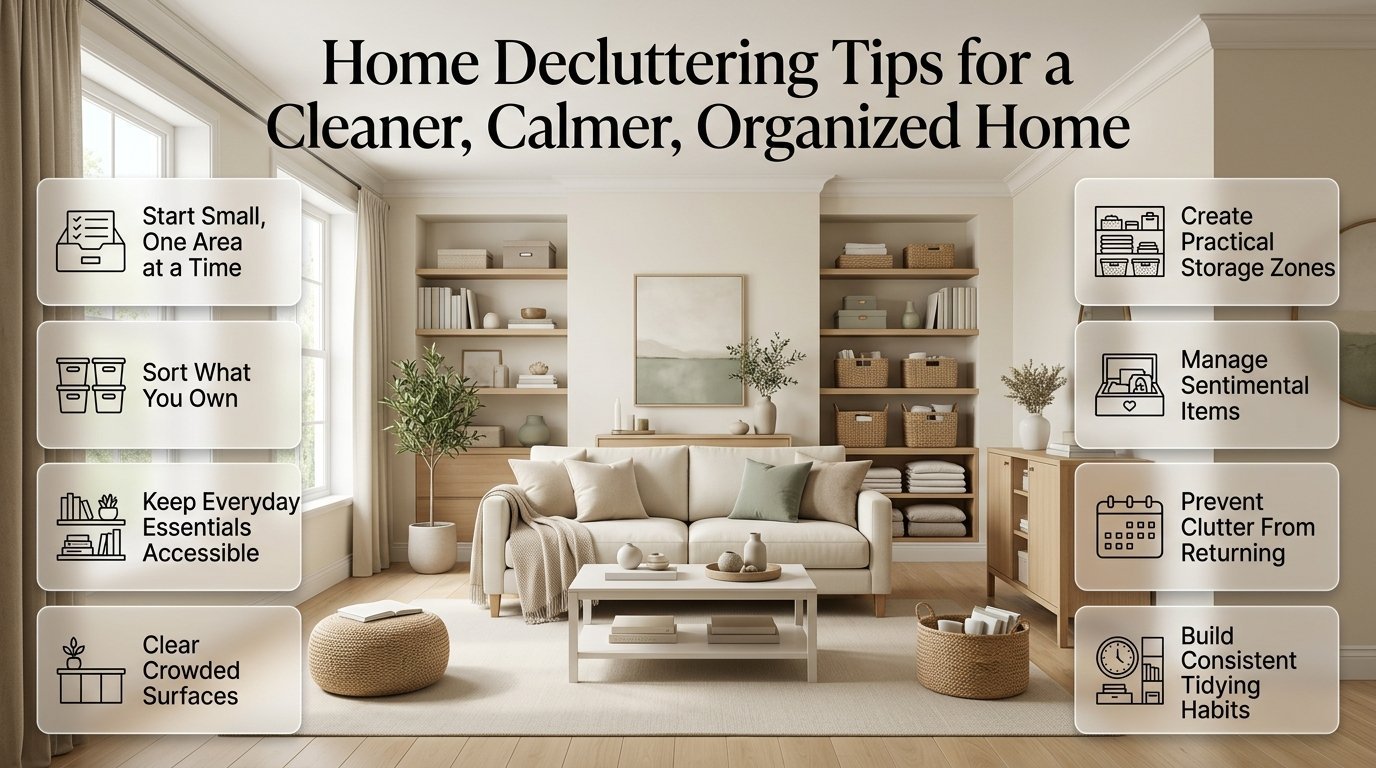
The easiest way to start decluttering is to choose one small area, set a realistic time limit, and make decisions about individual belongings rather than trying to organize the entire house simultaneously. A finished drawer or clear countertop provides visible progress without creating several unfinished projects.
Step 1: Identify Your Biggest Clutter Problem
Walk through your home and notice which areas cause the most inconvenience.
Perhaps your kitchen counter is difficult to use, your bedroom chair has become a place for unworn clothing, or your entryway is crowded with shoes and bags. Identify the problem that affects your daily routine most often.
Write down three priority areas and start with the easiest one.
For example:
- Clear the kitchen counter.
- Sort the bedside table.
- Organize the shoes near the entrance.
This creates a manageable starting point and helps you avoid switching between unrelated tasks.
Step 2: Choose a Small, Defined Area
A broad goal such as decluttering the bedroom can become overwhelming because it includes furniture, clothing, accessories, paperwork, and storage.
A smaller task has a clear endpoint.
Choose one of the following:
- One drawer.
- One shelf.
- One section of a wardrobe.
- One kitchen cupboard.
- One bathroom cabinet.
- One area of a desk.
- One surface that collects miscellaneous items.
Work through that area before moving to another. If you have limited time, a single completed task is more useful than emptying several cupboards and leaving them unfinished.
Step 3: Prepare Four Sorting Categories
Use existing boxes, bags, or separate areas to classify your belongings.
| Category | What to do |
|---|---|
| Keep | Retain items that serve a useful purpose or hold genuine personal value |
| Donate or give away | Pass on suitable items that are still usable |
| Recycle or discard | Dispose of unwanted items according to their condition and local rules |
| Relocate | Return belongings to the rooms or storage areas where they belong |
Avoid creating too many categories. A complicated sorting system can slow down decisions and make the process harder to maintain.
Remember that not everything should be donated. Damaged, contaminated, unsafe, or unsuitable items may require responsible disposal instead.
Step 4: Remove the Easy Decisions First
Start with items that clearly no longer serve a purpose.
Examples include empty packaging, dried-out stationery, broken objects you do not intend to repair, unnecessary duplicates, and rubbish that has accumulated in drawers.
Once these items are removed, consider belongings that require more thought.
Pro Tip: If you are unsure about an ordinary item, ask yourself whether you would deliberately choose to keep it if you were organizing the area from scratch. This question can help you separate genuine usefulness from automatic keeping.
Step 5: Complete the Area Before Stopping
Once sorting is finished, clean the cleared surface, return the items you are keeping, and remove the unwanted belongings from the work area.
Put relocated objects in their appropriate rooms. Arrange donations for collection or delivery, and handle recycling and rubbish correctly.
A completed area should be usable again without requiring another major organizing session.
3. How Do You Decide What to Keep and What to Remove?
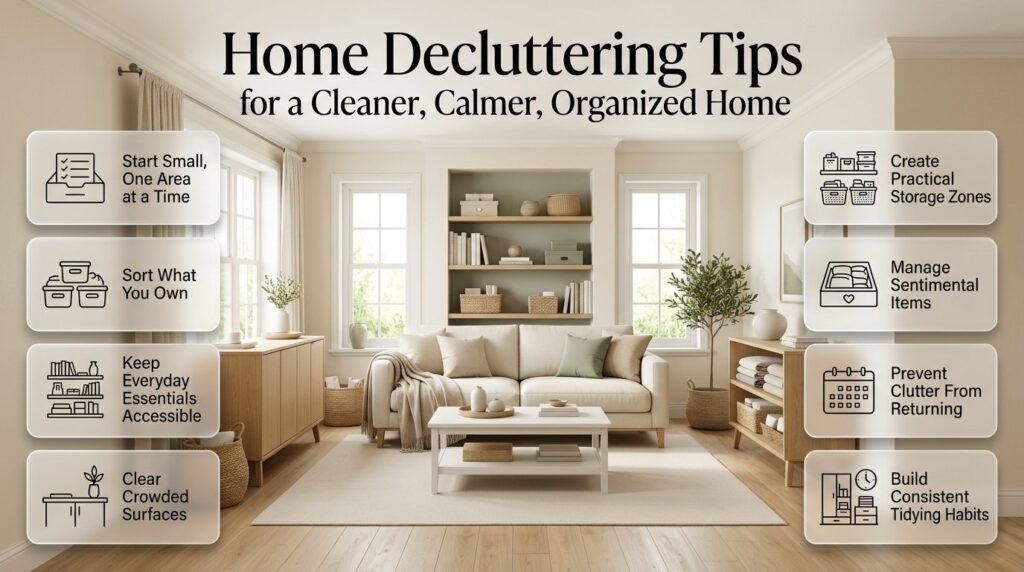
The best way to decide what stays in your home is to consider usefulness, condition, frequency of use, replacement difficulty, and personal importance. No single rule works for every possession, so combine practical questions with common sense instead of following strict numerical limits.
Ask These Questions About Each Item
When you are uncertain, consider the following:
- Have I used this item recently?
- Does it serve a specific purpose?
- Is it in suitable working condition?
- Do I own another item that does the same job?
- Is there a realistic situation in which I will need it?
- Is it difficult or expensive to replace?
- Does it hold genuine sentimental or personal value?
You do not need to answer every question for every object. The aim is to make a reasonable decision without spending excessive time evaluating ordinary belongings.
For example, keeping a spare torch for emergencies makes sense even if you rarely use it. Keeping several broken torches that cannot be repaired is less useful.
Use the One-Year Rule as a Guide, Not a Requirement
The one-year rule encourages you to consider whether you have used an item during the previous twelve months.
It can help with everyday clothing, unused kitchen gadgets, decorative accessories, and duplicate household supplies. However, it should not automatically determine what stays.
Seasonal decorations, travel equipment, formal clothing, emergency supplies, and special-purpose tools may be used infrequently but remain valuable.
Before removing an item, consider when it is needed, how much space it occupies, and whether keeping it serves a clear purpose.
What Should You Do With Expensive Items You No Longer Use?
People often retain expensive purchases because letting them go feels like admitting a mistake. However, money already spent cannot be recovered simply by keeping an unwanted object.
Consider whether the item can be sold, returned if eligible, donated, or passed to someone who can use it.
Set a reasonable deadline for selling belongings. If an item remains unsold after your chosen period, decide whether another destination makes more sense.
This prevents resale projects from becoming permanent clutter.
How Should You Handle Duplicates?
Duplicates are not always unnecessary. Spare towels, basic tools, kitchen utensils, and household supplies may serve useful purposes.
The important question is whether the quantity matches your actual needs.
For example, a family that regularly prepares large meals may need several cooking utensils. A person who rarely cooks may find that a smaller selection is easier to manage.
Keep the quantity that supports your routine without allowing duplicates to occupy space needed for other belongings.
4. How Can You Declutter Your Living Room Effectively?
The living room should provide comfortable space for relaxing, entertaining, reading, and spending time together. Decluttering this area means removing items that interfere with those activities while preserving decorations and belongings that make the room feel personal.
Start with the visible surfaces because these areas often collect unrelated objects.
Clear Coffee Tables and Side Tables
Remove cups, packaging, unused stationery, misplaced accessories, and items that belong elsewhere.
Keep only the objects that support how you use the room. A small tray can hold frequently used remotes, while a suitable basket can contain a few regularly used blankets.
Avoid filling every cleared surface with new decorations simply because space has become available.
Review Books, Magazines, and Decorative Objects
Books and decorations can add character to a room, but overcrowded shelves may become difficult to clean and maintain.
Review magazines you have already read, books you no longer want, and decorative objects that no longer suit the space.
Keep meaningful collections intentionally. You do not need to remove everything to create a more organized appearance.
Organize Toys, Games, and Entertainment Accessories
If your living room is shared by children or several household members, create accessible locations for toys, board games, charging cables, and remote controls.
Group similar items together and make sure everyone knows where they belong.
For more detailed guidance on arranging a functional shared space, explore Living Room Home Tips.
5. What Is the Best Way to Declutter a Bedroom?
A bedroom is easier to use when clothing, personal accessories, bedding, and bedside belongings are stored according to everyday needs. Start by clearing the floor and visible surfaces, then review wardrobes and drawers without emptying every storage area at once.
Start With the Bedside Table
Bedside tables often collect books, charging cables, receipts, water glasses, medicines, and miscellaneous objects.
Remove rubbish and relocate anything that does not need to remain beside the bed.
Keep regularly used items accessible, such as a reading light, the book you are currently reading, or other personal essentials.
Review Clothing One Category at a Time
Wardrobes can become crowded when clothing is retained without considering comfort, condition, or current use.
Sort clothing into manageable groups:
- Everyday clothing.
- Work or school clothing.
- Special-occasion outfits.
- Seasonal garments.
- Sportswear and activity-specific clothing.
- Accessories.
Consider whether each item is comfortable, suitable for your current needs, and in wearable condition.
Clothing that no longer serves you may be suitable for donation or resale, provided it meets the recipient’s requirements.
Declutter Drawers and Under-Bed Storage
Check drawers for duplicate accessories, unused stationery, old packaging, and items that belong elsewhere.
Under-bed storage can be useful for seasonal bedding or clothing, but it should not become a place where unwanted belongings disappear from view.
Keep stored items accessible and use containers suitable for protecting them from dust and moisture.
For more room-specific guidance, visit Bedroom Organization Tips.
6. How Do You Declutter a Kitchen Without Disrupting Daily Cooking?
Kitchen decluttering should make meal preparation easier by improving access to frequently used utensils, cookware, ingredients, and food containers. Work on one cabinet or category at a time so that essential cooking items remain available throughout the process.
Declutter Kitchen Countertops
Counters are useful work surfaces, but they often become storage areas for items that have no designated home.
Remove unrelated paperwork, empty packaging, unused decorations, and equipment that can be stored safely elsewhere.
Keep appliances on the counter when they are used frequently and fit the available space. There is no need to remove a useful appliance merely to achieve a minimalist appearance.
Sort Drawers and Cooking Utensils
Take out unnecessary duplicates and review the condition of tools you rarely use.
Keep cooking utensils together, place knives in appropriate safe storage, and arrange commonly used tools where they are easy to reach.
Avoid keeping damaged utensils simply because they may be useful someday if a replacement is inexpensive and the item is no longer safe or functional.
Organize the Pantry
Review pantry items by category, such as grains, baking ingredients, canned foods, snacks, and cooking essentials.
Check dates, storage instructions, and packaging condition. Remove expired or spoiled products appropriately, and place frequently used ingredients where they are easy to access.
Use original packaging when it helps preserve important ingredient, allergen, or expiration information. Decorative matching containers are optional, not a requirement.
Review Food Containers and Kitchen Gadgets
Match food containers with their lids and identify pieces that are cracked, damaged, or no longer useful.
For kitchen gadgets, consider how often you use them and whether another tool already performs the same function.
If you use a specialist appliance regularly, keep it. If you bought a gadget for a single recipe and have not used it since, consider whether it deserves the storage space.
For additional guidance, see Kitchen Organization Tips.
7. How Can You Declutter Bathrooms and Laundry Areas?
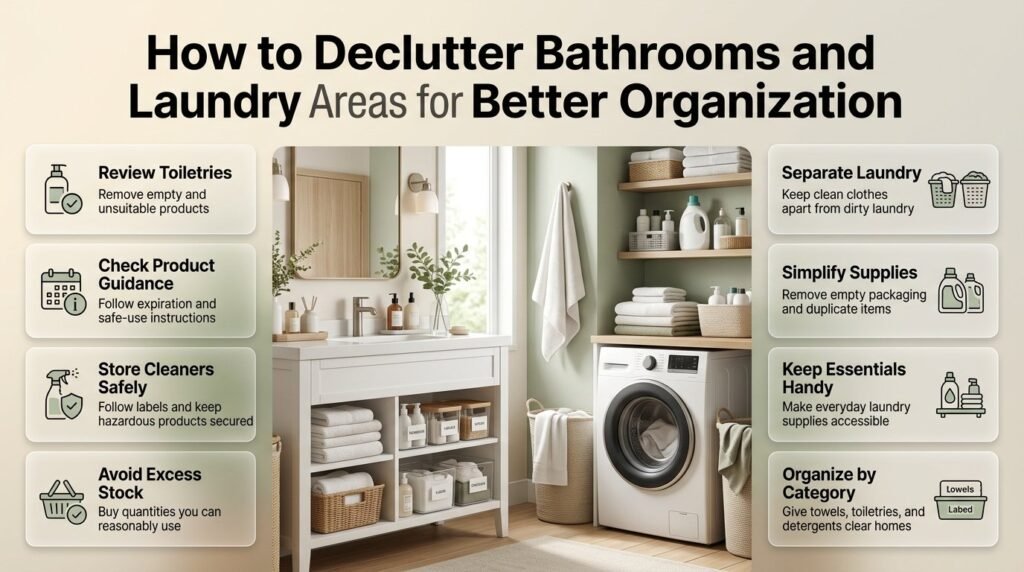
Bathrooms and laundry spaces become cluttered when products, cleaning supplies, towels, and everyday essentials accumulate faster than they are used. The most effective solution is to keep suitable quantities of useful items and create clear storage locations for each category.
Review Toiletries and Personal Care Products
Begin with the bathroom vanity, shower area, and storage cabinets.
Remove empty containers and review products that no longer suit your needs. Follow manufacturer instructions for expiration dates and safe use.
Avoid keeping large quantities of products simply because they were purchased on sale. Buying more than you can reasonably use can create unnecessary storage problems.
Store Cleaning Supplies Safely
Group suitable cleaning products together and store them according to their labels.
Keep hazardous products away from children and pets, and never mix cleaning chemicals unless the product instructions explicitly allow it.
Dispose of unwanted chemicals according to local guidance rather than pouring them down drains when prohibited.
Simplify Laundry Storage
Laundry areas work better when clean clothes, dirty laundry, detergents, and household linens have separate locations.
Remove empty product packaging and review unused accessories or duplicate supplies.
Keep frequently used detergents accessible while ensuring that products remain safely stored. If space is limited, prioritize the items needed for regular laundry rather than filling shelves with rarely used products.
8. How Do You Declutter an Entryway and Home Office?
Entryways and home offices need different decluttering strategies because one manages items moving into and out of the home, while the other supports paperwork, technology, and focused tasks.
Create a Practical Entryway System
Shoes, bags, keys, coats, umbrellas, and delivery packages often collect near the entrance.
Assign everyday items a convenient location:
- Use hooks for frequently carried bags and coats.
- Store everyday shoes in an accessible rack.
- Keep keys in one consistent place.
- Remove delivery packaging promptly.
- Relocate seasonal accessories when they are not needed.
Do not add bulky storage furniture if it blocks the walking route. A small, well-planned arrangement is often more useful than a large cabinet that makes the entrance difficult to navigate.
Reduce Paper and Desk Clutter
Start by separating active documents from paperwork that no longer needs to remain on your desk.
Create a simple system for current projects, bills, important records, and documents requiring action.
Before discarding paperwork, check whether it contains financial, legal, educational, medical, or other information that should be retained. Dispose of sensitive documents securely.
Organize Cables and Digital Files
Group useful cables and accessories together, label them when necessary, and remove damaged items through appropriate disposal channels.
Digital decluttering can also help reduce the time spent searching for information.
Review duplicate downloads, unnecessary screenshots, old files, and outdated desktop shortcuts. Back up important information before deleting files, and check whether any records are needed for future reference.
9. How Can You Declutter a Small Home With Limited Storage?
Small homes benefit from thoughtful decisions about what to keep, where to store it, and how each area is used. When space is limited, reducing unnecessary possessions is often more effective than adding another storage container.
Prioritize the Most Important Belongings
Identify the items you use daily, weekly, seasonally, or only for specific occasions.
Everyday essentials should be easy to reach. Less frequently used belongings can occupy suitable secondary storage, provided they remain accessible when needed.
Avoid keeping large quantities of items simply because they fit into a cabinet. Storage capacity is not a reason to retain unnecessary belongings.
Use Vertical Space Where Appropriate
Wall shelves, hooks, tall cabinets, and suitable over-door organizers can increase storage capacity without occupying much floor space.
However, vertical storage should remain practical and safe.
Secure shelves correctly, respect weight limits, and avoid storing heavy objects where they could fall or require unsafe reaching.
Choose Furniture Based on Function
Furniture with built-in storage can be helpful, but it should suit the room’s dimensions and everyday needs.
Before buying a storage bench, cabinet, or additional shelving, consider whether removing unnecessary belongings would solve the problem more simply.
Keep walking routes clear and avoid furniture that makes frequently used areas difficult to access.
For further ideas, explore Small Space Home Tips and Home Storage Solutions.
10. How Do You Declutter Sentimental Belongings Without Regret?
Sentimental belongings require a different approach because their importance may come from personal memories rather than practical usefulness. You can preserve meaningful connections while reducing unnecessary clutter by deciding which objects deserve space and how you want to store them.
Keep Meaningful Items Intentionally
Photographs, letters, gifts, family heirlooms, and souvenirs may represent important experiences.
Instead of asking whether an item is useful, consider what it means to you and whether keeping it contributes to your life today.
You do not need to discard sentimental belongings to prove that you are organized.
Select Representative Items From Large Collections
If you have many objects connected to the same event or person, choose the ones that hold the most meaning.
For example, you might retain a few particularly meaningful travel souvenirs instead of keeping every ticket, brochure, and small purchase from the trip.
Photographs can preserve memories of objects you no longer wish to store, although they do not need to replace every physical keepsake.
Create a Defined Keepsake Area
A dedicated box, shelf, or suitable cabinet can protect meaningful possessions and prevent them from spreading throughout the home.
Choose storage that protects items from dust, moisture, and physical damage.
If a decision feels difficult, put the item aside and return to it later. Decluttering is more sustainable when you can make thoughtful choices without rushing.
11. What Are the Best Decluttering Methods for Busy Households?
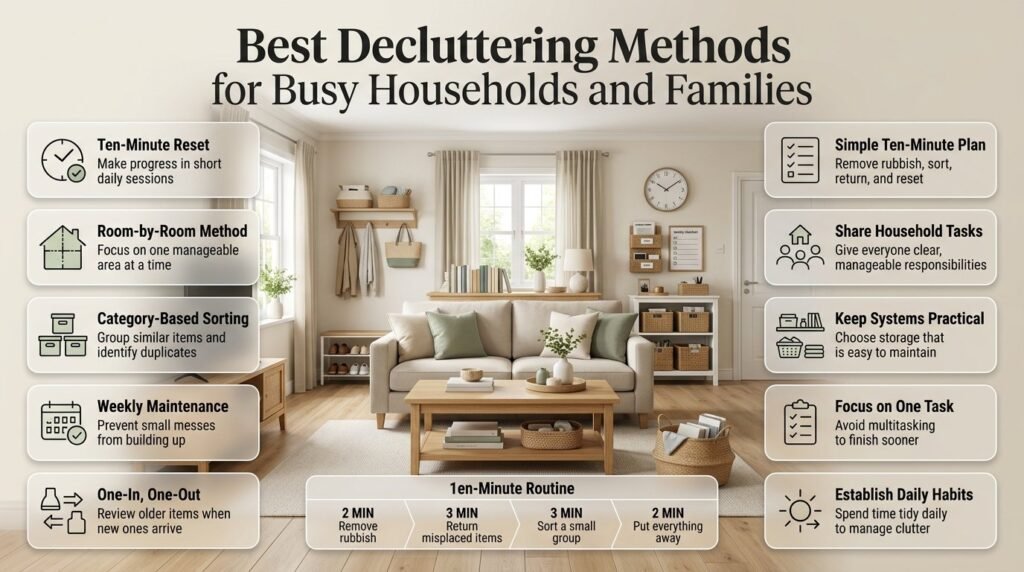
The best decluttering method is one that fits your schedule and can be repeated consistently. Some people prefer short daily sessions, while others make more progress by working on a single category or room during a planned block of time.
| Method | Best suited to | Main benefit |
|---|---|---|
| Ten-minute reset | Busy weekdays | Fits into short periods of free time |
| Room-by-room method | Larger home projects | Creates clear, measurable progress |
| Category method | Clothes, books, or kitchen tools | Helps identify duplicates |
| One-in, one-out | Managing new purchases | Limits accumulation in selected categories |
| Weekly maintenance | Shared family spaces | Prevents small messes from becoming larger problems |
Try the Ten-Minute Method
Choose one area and work for ten minutes.
- Spend two minutes removing rubbish.
- Spend three minutes returning misplaced belongings.
- Spend three minutes sorting a small group of items.
- Spend two minutes putting things away and preparing the area for future use.
Adjust the timing to suit the task. If the area requires more work, stop at a safe, convenient point and continue later.
Use the One-In, One-Out Rule Selectively
When a new item enters your home, consider whether an older item in the same category can leave.
For example, if you purchase a new mug, you might donate one you no longer use. If you replace a kitchen appliance, decide whether the old one should be sold, donated, recycled, or discarded.
This method is useful for categories that frequently accumulate, but it should not become an unnecessary rule for essential supplies or items that serve different purposes.
Involve Household Members
Shared spaces stay organized more easily when everyone understands the storage arrangement.
Give family members clear, manageable responsibilities, such as returning shoes to the rack or putting away their own books.
Avoid assigning complicated systems that require constant supervision. Simple categories and convenient storage locations are more likely to work over time.
12. What Common Decluttering Mistakes Should You Avoid?
Decluttering becomes unnecessarily difficult when people take on too much, buy storage products before sorting, or create systems that do not match their routines. Understanding these mistakes helps you make progress without adding more work.
Mistake 1: Emptying Every Cupboard at Once
Why it happens: People expect a large project to produce faster results.
Why it creates problems: Multiple unfinished areas disrupt daily activities and make it difficult to locate essential belongings.
Better approach: Finish one manageable section before moving to the next.
Mistake 2: Buying Organizers Too Early
Why it happens: Containers appear to offer an immediate solution.
Why it creates problems: They may hide unnecessary belongings without reducing clutter.
Better approach: Declutter first, measure your remaining storage needs, and purchase only what solves a specific problem.
Mistake 3: Keeping Everything Because It Might Be Useful
Why it happens: People want to avoid waste or future inconvenience.
Why it creates problems: Low-value belongings accumulate and compete with items that are genuinely important.
Better approach: Consider realistic future use, replacement difficulty, condition, and storage requirements.
Mistake 4: Setting Unrealistic Deadlines
Why it happens: Initial motivation encourages ambitious plans.
Why it creates problems: A schedule that conflicts with work, school, family, or other responsibilities is difficult to maintain.
Better approach: Set small goals that fit your available time and energy.
Mistake 5: Moving Clutter Instead of Removing It
Why it happens: Transferring belongings to another room makes the original area look cleaner.
Why it creates problems: The total amount of clutter remains unchanged.
Better approach: Relocate useful items to their proper homes and make deliberate decisions about everything else.
Mistake 6: Expecting a Perfectly Minimalist Home
Why it happens: Images of highly simplified interiors can create unrealistic expectations.
Why it creates problems: People may remove useful or meaningful belongings unnecessarily and feel dissatisfied with a perfectly functional home.
Better approach: Define success according to your household’s needs, available space, and preferred way of living.
13. What Professional Organizing Principles Help Prevent Clutter?
Practical organizing systems are designed around how people actually use their homes. The most useful principles make belongings easy to find, reduce unnecessary movement, and simplify the process of putting things away.
Follow the Point-of-Use Principle
Store items near the activities they support.
Keep cooking tools near the food preparation area, work supplies near the desk, and everyday shoes near the entrance.
This reduces unnecessary movement and makes it easier to return belongings after use.
If an item repeatedly ends up in the wrong place, consider whether its designated storage location is inconvenient.
Make Storage Easy to Maintain
An organizing system should work on an ordinary day, not only immediately after a thorough cleanout.
For example, a basket may be more practical for frequently used blankets than a complicated arrangement requiring careful folding every time.
Likewise, a simple tray for keys may work better than a storage system that requires opening several drawers.
Avoid Filling Every Available Space
Empty space is useful because it allows you to access belongings, put away new items when necessary, and maintain clear surfaces.
You do not need to fill every shelf or drawer to make your home feel complete.
Leave enough room for ordinary movement and for the storage system to function without constant rearrangement.
Use Labels Only When They Solve a Problem
Labels can be helpful for shared cupboards, pantry categories, paperwork, children’s belongings, and seasonal storage.
However, labeling every small container may create unnecessary work.
Use labels when they reduce confusion or help other household members return items correctly.
Review the System After Using It
After a few weeks, notice which arrangements work and which ones repeatedly fail.
Perhaps a drawer is too crowded, a frequently used item is stored too far away, or a donation box has no convenient destination.
Make small adjustments rather than rebuilding the entire system.
14. How Can You Prevent Clutter From Returning?
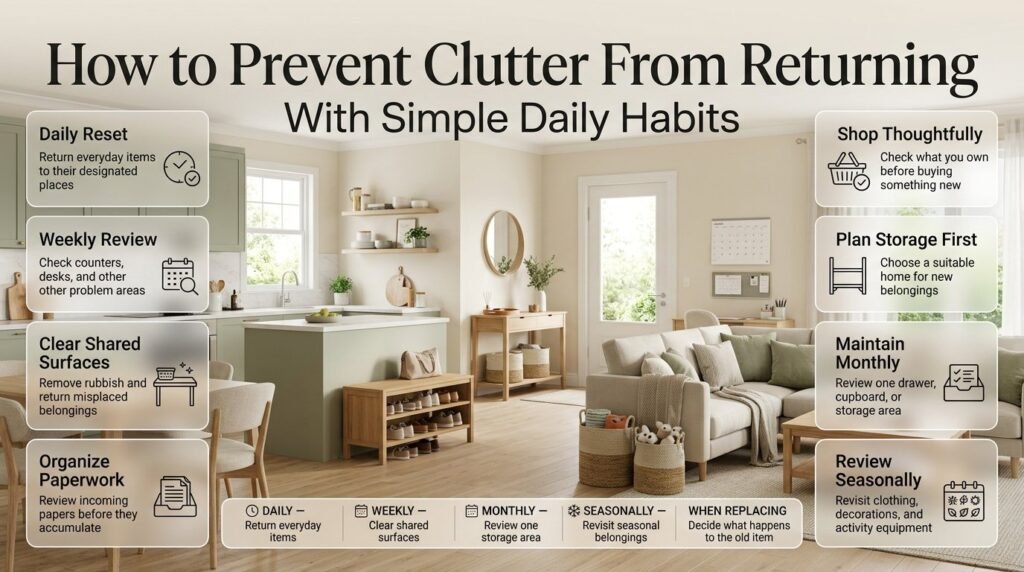
Long-term clutter prevention depends on managing incoming belongings, maintaining convenient storage locations, and dealing with small messes before they become larger projects. You do not need to keep your home perfectly tidy every hour; you need a practical routine that suits your household.
Establish a Simple Daily Reset
Choose a short period to return everyday belongings to their designated locations.
You might clear the kitchen counter, put away living-room items, return shoes to the rack, and gather misplaced objects.
The routine should be short enough to repeat without creating additional stress.
Review Problem Areas Weekly
Certain spaces may require more frequent attention because they naturally collect belongings.
These often include:
- Kitchen counters.
- Entryway tables.
- Bedside surfaces.
- Laundry areas.
- Home office desks.
- Family activity areas.
Spend a few minutes reviewing these spaces each week. Remove rubbish, return misplaced items, and address anything that has begun to accumulate.
Be Thoughtful About New Purchases
Before bringing something home, consider whether you already own a suitable alternative and where the new item will be stored.
You can reduce unnecessary accumulation by declining unwanted promotional items, reviewing shopping carts before purchasing, and borrowing occasionally used equipment when practical.
Avoid purchasing storage products simply because a sale makes them seem attractive.
Create a Flexible Maintenance Schedule
| Frequency | Suggested task |
|---|---|
| Daily | Return frequently used items to their designated places |
| Weekly | Clear shared surfaces and review incoming paperwork |
| Monthly | Revisit one drawer, cupboard, or storage area |
| Seasonally | Review clothing, decorations, and activity-specific equipment |
| When replacing items | Decide what happens to the old belongings |
Adjust this schedule to your household’s needs. The objective is to make maintenance predictable, not to create another demanding checklist.
For additional practical routines, explore Smart Home Organization Tips and Easy Home Cleaning Tips.
15. What Should You Do With Belongings You No Longer Need?
Once you decide that an item should leave your home, choose a suitable destination and complete that step rather than allowing unwanted belongings to accumulate in bags and boxes.
Donate Useful Items
Clothing, books, household goods, and other belongings may be suitable for donation if they are clean, functional, and accepted by the receiving organization.
Check donation requirements before transporting items. Some organizations cannot accept particular materials or damaged goods.
Sell Items With Realistic Resale Value
Selling may be worthwhile for useful products that retain meaningful secondhand value.
However, photographing, listing, answering messages, and arranging collection all take time. Choose a reasonable deadline and reconsider the plan if an item remains unsold.
Recycle Suitable Materials
Use local recycling services for materials they accept. Electronics, batteries, and certain household products may require specialist collection.
Do not assume that every plastic item, electrical product, or mixed-material object belongs in ordinary recycling.
Dispose of Unusable Items Responsibly
Broken, contaminated, unsafe, or unsuitable items may need to be discarded according to local rules.
Special waste should be handled through appropriate channels rather than placed in ordinary rubbish when prohibited.
Quick Tip: Keep a small donation bag in a convenient location, but empty it regularly. A donation bag is a temporary collection point, not a permanent storage solution.
16. A Practical Seven-Day Home Decluttering Plan
A short plan can help you turn general intentions into specific tasks. This seven-day schedule focuses on manageable areas and allows you to make progress without disrupting every room simultaneously.
| Day | Focus area | Main task |
|---|---|---|
| Day 1 | Living room | Clear visible surfaces and return misplaced belongings |
| Day 2 | Bedroom | Review bedside tables and one clothing category |
| Day 3 | Kitchen | Sort one drawer, cabinet, or pantry section |
| Day 4 | Bathroom | Review toiletries and remove empty packaging |
| Day 5 | Entryway | Organize shoes, bags, keys, and coats |
| Day 6 | Home office | Sort desk supplies and review unnecessary paperwork |
| Day 7 | Maintenance | Complete donation arrangements and review progress |
Spend as much time as your schedule allows. You may need more than one day for a particular area, and that is perfectly reasonable.
The schedule is intended to create structure, not pressure. If you cannot finish a task, divide it into smaller sections and continue when convenient.
How to Measure Your Progress
Do not measure success solely by how many bags you remove or how empty your cupboards look.
Instead, ask practical questions:
- Can I find frequently used belongings more easily?
- Are the main surfaces available for their intended purposes?
- Is cleaning easier than before?
- Can household members return items to the right places?
- Have I reduced unnecessary purchases or duplicate belongings?
- Does the arrangement work with my everyday routine?
These measures reflect whether decluttering has improved the way you use your home.
What Is the Best Way to Declutter Your Home Without Feeling Overwhelmed?
The best way to declutter your home is to work on one small area at a time instead of trying to organize every room in a single day. Begin with a space that affects your daily routine, such as a kitchen counter, bedroom drawer, or crowded entryway. Remove unnecessary belongings, group similar items, and return the things you need to their designated places. Completing one area before starting another makes the process easier to manage and helps you maintain consistent progress.
Practical tips:
Set aside 10–20 minutes for one specific task.
Use separate categories for items to keep, donate, recycle, or relocate.
Finish each area before moving to another.
Take short breaks when sorting becomes tiring.
How Do You Decide What to Keep and What to Get Rid of When Decluttering?
Deciding what to keep becomes easier when you evaluate each item’s usefulness, condition, frequency of use, and personal importance. Ask yourself whether you use it, whether it serves a specific purpose, and whether you already own something that performs the same function. Avoid keeping unnecessary belongings solely because they were expensive or might become useful someday. However, seasonal equipment, emergency supplies, important documents, and sentimental possessions may deserve space even when they are not used regularly.
Practical tips:
Remove broken items you have no realistic plan to repair.
Donate usable belongings that no longer meet your needs.
Review duplicate kitchen tools, clothing, and household accessories.
Keep meaningful keepsakes without feeling pressured to discard them.
Check document-retention requirements before disposing of important paperwork.
How Can You Declutter a Small Home With Limited Storage Space?
Decluttering a small home starts with reducing unnecessary possessions and making the best use of the storage space already available. Rather than purchasing additional cabinets immediately, review what you own and prioritize belongings that support your everyday activities. Use vertical shelves, wall hooks, drawer organizers, and suitable under-bed storage when they improve accessibility. Keep frequently used items within easy reach, and avoid filling every available shelf simply because space exists.
Practical tips:
Store belongings close to where you use them.
Choose furniture with built-in storage when it suits your room.
Keep floors and walking routes clear.
Use vertical storage safely and respect weight limits.
Measure available space before purchasing organizers.
How Often Should You Declutter Your Home to Keep It Organized?
The best decluttering schedule combines small daily habits with regular reviews of areas that tend to accumulate belongings. A short evening reset can help keep surfaces clear, while a weekly review can address paperwork, misplaced items, and crowded shared spaces. Monthly or seasonal sessions are useful for reviewing wardrobes, storage cupboards, decorations, and equipment that changes with the weather. The ideal schedule depends on your household, available time, and how quickly clutter returns.
Practical tips:
Spend a few minutes each day returning items to their proper places.
Review clutter-prone areas once a week.
Check seasonal belongings when their storage needs change.
Follow the one-in, one-out approach for categories that accumulate.
Adjust your routine instead of setting unrealistic deadlines.
What Should You Do With Items You No Longer Need After Decluttering?
Once you have decided to remove an item, choose a suitable destination based on its condition and usefulness. Clean, functional belongings may be donated or given to someone who needs them, while valuable items may be worth selling if you can manage the process within a reasonable timeframe. Materials accepted by local recycling services should be recycled appropriately, and damaged or hazardous items may require special disposal arrangements. Completing this step promptly prevents unwanted belongings from collecting in bags, boxes, or spare rooms.
Practical tips:
Check donation requirements before dropping off belongings.
Set a deadline for selling unwanted items.
Recycle accepted materials according to local guidelines.
Dispose of electronics, batteries, and chemicals through appropriate channels.
Schedule donation collection or delivery instead of leaving bags indefinitely.
Conclusion: Create a Cleaner, Calmer Home With Practical Decluttering Tips
Effective home decluttering is not about removing everything you own or creating a perfectly styled space. It is about making thoughtful decisions, keeping useful belongings accessible, and creating an environment that supports your daily routine. With a clear plan and consistent habits, you can make your home feel more organized, comfortable, and easier to maintain without trying to complete everything in one day.
Start with one manageable area, such as a drawer, kitchen counter, wardrobe shelf, or bedside table. Sort your belongings into practical categories, give frequently used items a designated place, and make a realistic plan for donating, recycling, or responsibly disposing of things you no longer need. Small improvements can gradually transform crowded rooms into functional spaces that feel easier to use and maintain.
Remember that successful decluttering depends on consistency rather than perfection. Simple routines, regular reviews, and suitable storage solutions can help prevent unnecessary clutter from returning. Whether you live in a spacious house or a small apartment, the right approach can help you make better use of your available space and establish more sustainable organizing habits.
For more practical inspiration, Heartomenal offers helpful ideas for creating a cleaner, more organized, and comfortable home. Start with one small change today, build on your progress, and make decluttering a practical part of your everyday home care routine.
Leave a Reply