Introduction
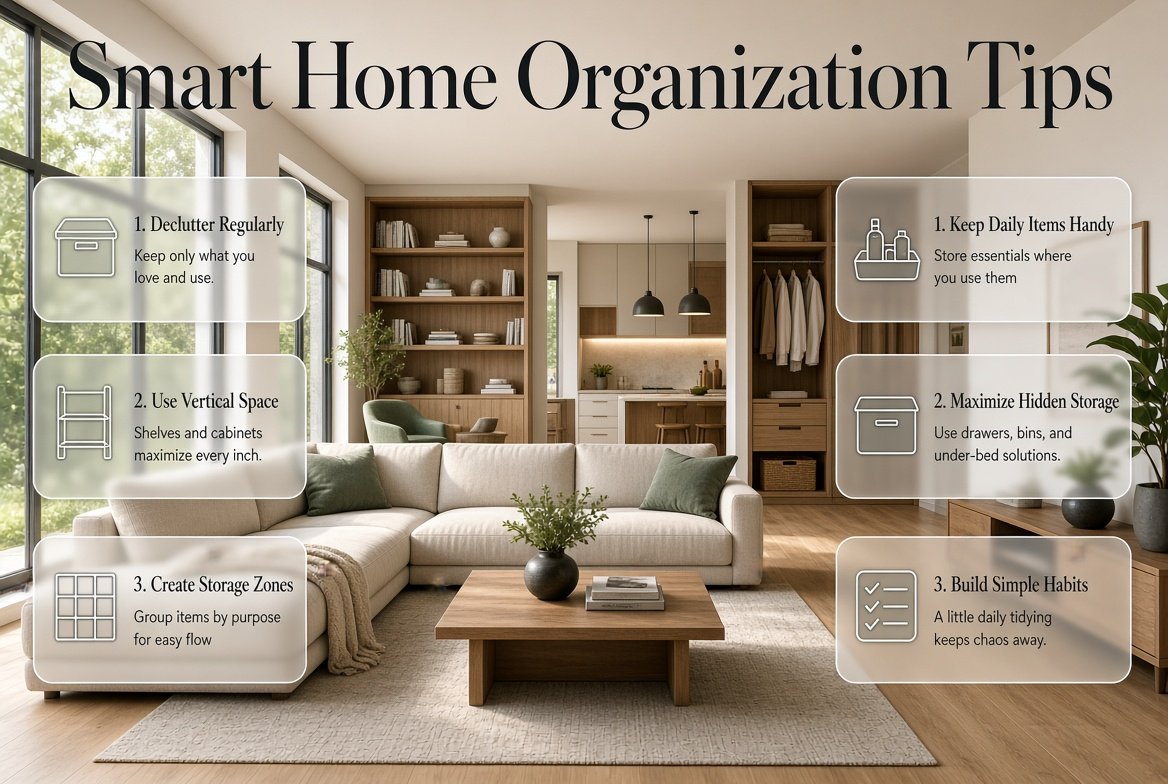
Smart Home Organization Tips | A home should make everyday life easier, but cluttered kitchen counters, overflowing wardrobes, crowded shelves, and misplaced belongings can turn simple tasks into frustrating routines. You might clean your home regularly and still feel that everything becomes messy again within a few days. In many cases, the problem isn’t the size of your home. It’s how your belongings are arranged and how easily you can maintain that arrangement.
Smart home organization tips can help you create a cleaner, more functional living environment without spending a fortune on storage products or renovating every room. By combining practical decluttering methods, efficient storage solutions, and simple daily habits, you can make better use of the space you already have.
Whether you live in a compact apartment, a family house, or a home with limited storage, this guide will show you how to organize different rooms, maximize unused space, manage everyday belongings, and prevent clutter from returning. For more inspiration, explore Heartomenal, where you can discover ideas for making your home more comfortable, attractive, and practical.
What Are Smart Home Organization Tips?
Smart home organization tips are practical strategies for arranging belongings, creating efficient storage systems, and establishing routines that keep a home functional and manageable. The purpose is not simply to hide clutter. It’s to make everyday items easy to find, use, and return to their proper places.
An organized home should reflect the way its occupants actually live. A family that cooks frequently needs an accessible kitchen arrangement, while someone working remotely may benefit from a dedicated workspace with organized documents and equipment.
Effective home organization generally focuses on four principles:
- Accessibility: Frequently used belongings should be easy to reach.
- Functionality: Each room should support the activities that take place there.
- Space efficiency: Storage should make good use of available areas without overcrowding rooms.
- Maintainability: The system should be simple enough to follow during busy days.
For example, storing cooking utensils beside the food preparation area saves time, while keeping keys in a designated tray near the entrance reduces the chances of losing them.
The best organization system isn’t necessarily the most expensive or visually impressive. It’s the one that makes your daily routines easier.
Why Is Home Organization Important?
Home organization improves the way you use your living space by reducing unnecessary searching, simplifying cleaning, and making household routines more predictable. It also helps you understand what you own, avoid duplicate purchases, and maintain a more comfortable environment.
1. It Saves Time During Everyday Activities
Small inconveniences can consume a surprising amount of time. Searching for a phone charger, locating a particular kitchen tool, or looking through several drawers for important paperwork interrupts your routine.
When belongings have consistent locations, you spend less time searching and more time completing the task you intended to do.
Start by organizing the items you use most frequently:
- Keys, wallets, and everyday bags.
- Chargers, headphones, and electronic accessories.
- Cooking utensils and food preparation tools.
- Cleaning supplies and laundry essentials.
- School materials, notebooks, and household documents.
Make sure the storage locations are convenient for everyone who uses them. If family members cannot easily identify where something belongs, they may leave it on a counter or table instead.
2. It Makes Your Home Feel More Spacious
A room can feel crowded even when it contains enough physical space. Unnecessary furniture, overloaded shelves, and belongings spread across surfaces can make movement difficult and reduce the room’s visual openness.
Before buying new furniture, assess what you already own and identify items that no longer serve a useful purpose.
You may be able to create more usable space by removing unused furniture, arranging storage vertically, or relocating belongings to appropriate rooms.
For example, a bedroom wardrobe may become easier to manage after you remove clothes that no longer fit and separate seasonal items from everyday outfits.
3. It Makes Cleaning Less Difficult
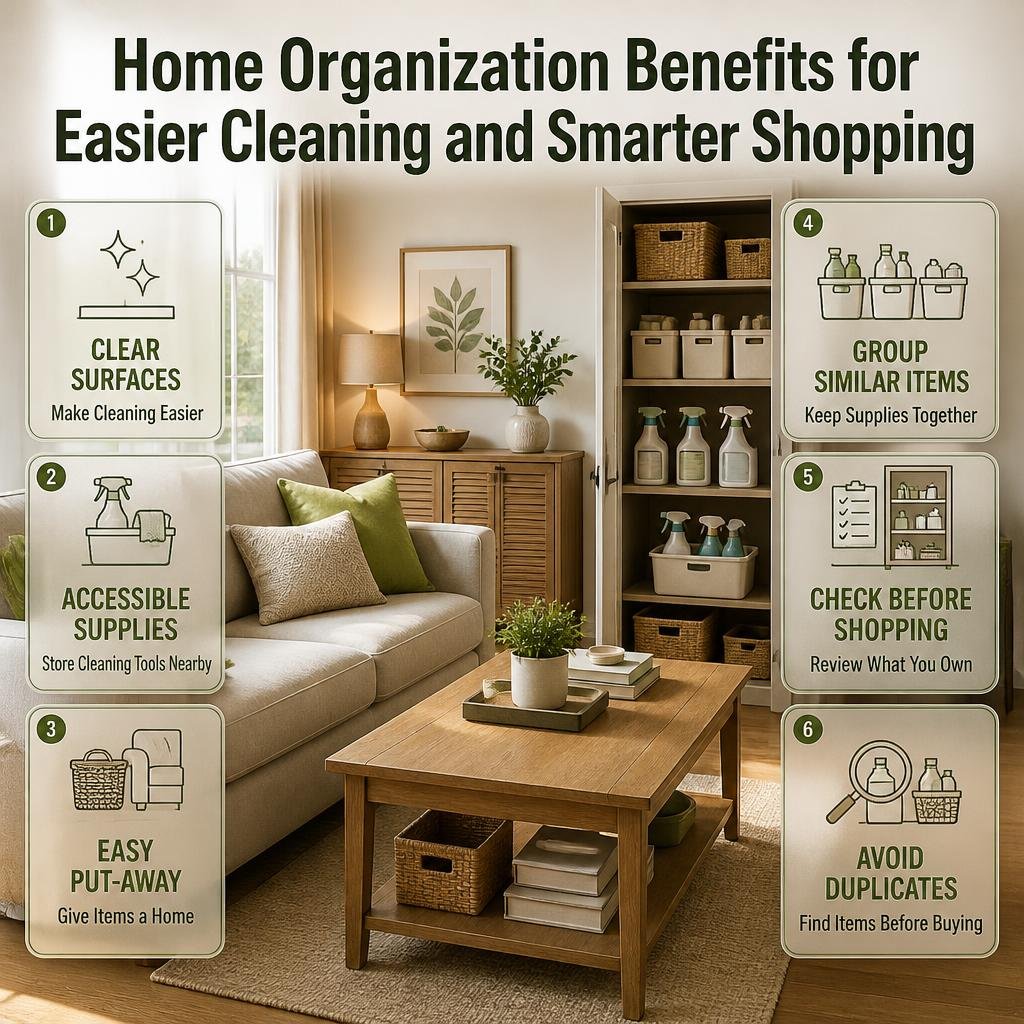
Cleaning becomes easier when floors, counters, and furniture surfaces are relatively clear. You can vacuum more efficiently, wipe surfaces without moving dozens of objects, and reach areas that might otherwise collect dust.
An organized home also makes it easier to return cleaning equipment to its proper place.
Pro Tip: Arrange frequently used items so that putting them away takes less effort than leaving them out. A basket near the sofa, a tray beside the entrance, or a laundry hamper in the right location can make a noticeable difference.
4. It Helps You Avoid Unnecessary Purchases
Disorganization can make people forget what they already own. You might purchase another household cleaner, charging cable, kitchen utensil, or pack of stationery because the existing one is hidden.
Grouping similar items together makes your inventory easier to understand.
Before shopping, check relevant cupboards, drawers, and storage boxes. You may discover that you already have enough supplies and only need to arrange them more effectively.
5. It Supports Better Household Routines
A practical organization system can make shared responsibilities easier. When everyone knows where laundry belongs, where household supplies are stored, and how to return frequently used items, the home becomes less dependent on one person constantly tidying up.
Clear storage locations also make it easier for children to develop age-appropriate habits and participate in everyday household tasks.
How to Make Everyday Home Cleaning Easier
Keeping your home clean does not have to involve a complicated routine or hours of work every day. A practical approach is to focus on small, manageable tasks, use suitable cleaning supplies, and establish a schedule that fits your household’s needs. If you want to make your routine more efficient, explore our guide to easy home cleaning tips for helpful ideas on maintaining tidy surfaces, managing everyday messes, and keeping frequently used spaces fresh. By building consistent habits and tackling minor cleaning tasks before they accumulate, you can create a more comfortable living environment without making household maintenance feel overwhelming.
How Should You Start Organizing Your Home?
The most manageable way to organize a home is to work on one defined area at a time. Start with a space that creates a recurring problem, remove unnecessary belongings, group the items you want to keep, and create a storage arrangement that suits your routine.
Trying to reorganize the entire house in one session can leave multiple rooms unfinished and create even more clutter.
Step 1: Identify Your Biggest Organization Problems
Walk through your home and notice which areas cause the most inconvenience.
Ask yourself:
- Where do belongings accumulate most quickly?
- Which drawers or cupboards are difficult to use?
- What items do I frequently lose?
- Which surfaces become cluttered every day?
- What takes the longest to clean?
- Which storage areas are filled with things I rarely use?
Choose one area with a clear problem. For example, if your kitchen counter is constantly crowded, begin there rather than opening every cupboard in the house.
Step 2: Set a Realistic Goal
A useful organization goal describes a specific result you can complete.
Instead of saying, “I need to organize my whole home,” try:
- Clear and organize one kitchen drawer.
- Arrange the shoes near the entrance.
- Sort one section of the wardrobe.
- Create a dedicated place for incoming paperwork.
- Organize the bathroom cabinet.
- Remove unused items from a bedside table.
Small tasks are easier to complete and allow you to test your approach before applying it elsewhere.
If a task is larger than expected, divide it into smaller stages. Completing one shelf properly is more useful than emptying an entire room and running out of time.
Step 3: Declutter Before Buying Storage
Decluttering should usually come before purchasing organizers because storage products cannot solve the underlying problem of owning more belongings than your space can comfortably accommodate.
Sort the contents of your selected area into four categories.
| Category | Appropriate action |
|---|---|
| Keep | Retain items that are useful, necessary, or meaningful. |
| Donate or give away | Pass on suitable items you no longer need. |
| Recycle or discard | Dispose of unwanted or unusable items responsibly. |
| Relocate | Move belongings that belong in another room. |
Be realistic when deciding what to keep. An item does not need to remain in your home simply because it was expensive, received as a gift, or purchased for a project you no longer pursue.
However, avoid rushing decisions about important documents, expensive equipment, emergency supplies, or sentimental possessions.
Step 4: Group Similar Belongings Together
Once you have decided what to keep, group related belongings.
For example, keep baking supplies together, organize chargers in a designated electronics area, and store cleaning cloths with appropriate household cleaning equipment.
Grouping items makes it easier to identify duplicates and determine how much storage you actually need.
It also prevents everyday belongings from becoming scattered across unrelated cupboards and drawers.
Step 5: Give Every Item a Practical Home
Each frequently used item should have a clear storage location.
Consider where you naturally use something and where you are most likely to put it away afterward.
Keys belong near the entrance, cooking utensils should be close to the preparation area, and laundry baskets should be positioned where clothes are regularly changed.
The more convenient the storage location, the more likely everyone is to use it consistently.
Step 6: Test Your System Before Expanding It
Use your new arrangement for several days before purchasing additional products or reorganizing other rooms.
Notice whether drawers open comfortably, whether items are easy to reach, and whether family members can return belongings without assistance.
If something repeatedly ends up on the counter instead of inside a cupboard, the cupboard may be inconveniently arranged.
Treat this as useful feedback. Adjust the system to suit your routine instead of expecting everyone to adapt to an impractical arrangement.
What Are the Best Smart Kitchen Organization Tips?
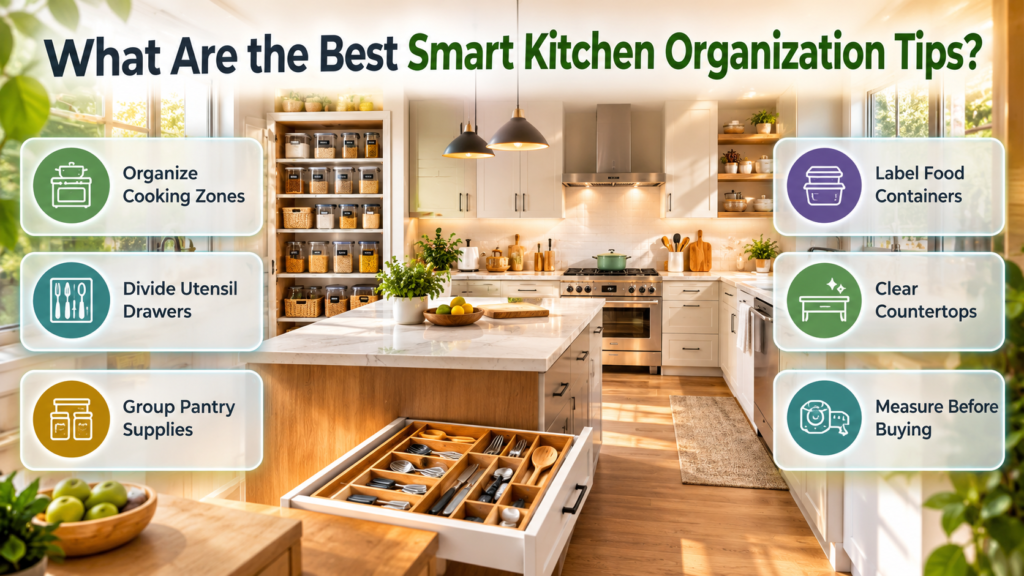
A well-organized kitchen keeps food, cooking equipment, utensils, and cleaning supplies easy to locate while preserving enough counter space for meal preparation. The most effective arrangement groups items by activity and places frequently used belongings close to where they are needed.
Organize the Kitchen Around Cooking Activities
Think about the tasks you perform in the kitchen, including food preparation, cooking, serving, washing, and storing groceries.
Create practical zones for these activities.
Food preparation zone: Keep suitable cutting boards, measuring tools, knives, and mixing bowls near the main preparation surface.
Cooking zone: Place commonly used utensils, oven-safe equipment, and appropriate cookware near the stove while maintaining safe distances from heat.
Cleaning zone: Store dishwashing supplies and cleaning cloths in an accessible location, separated from food and food-contact surfaces.
Food storage zone: Group pantry supplies by category so you can identify ingredients quickly and monitor quantities.
These zones do not require a large kitchen. Even a small counter and a few well-arranged cupboards can support a more efficient workflow.
Use Drawer Dividers for Small Kitchen Items
Kitchen drawers often become crowded with cutlery, measuring spoons, peelers, scissors, and miscellaneous accessories.
Drawer dividers separate these items and reduce the time spent searching for a particular tool.
Before buying a divider, measure the drawer and consider how much space your utensils require. Adjustable dividers can be useful when the drawer contains different types of equipment.
Avoid filling every compartment with rarely used gadgets. Keep the tools that support your actual cooking habits.
Make Pantry Storage Easier to Manage
Group pantry supplies such as grains, canned foods, spices, baking ingredients, snacks, and breakfast products.
Place frequently used ingredients where they are easy to reach, while heavier items should be stored at a safe and comfortable height.
Transparent containers can help you see suitable dry goods at a glance. However, transferring every product into a matching container is not essential.
If you use containers, make sure they are appropriate for food storage, clean, dry, and properly labeled. Preserve important information about ingredients, allergens, and expiration or best-before dates.
Use older suitable products before newer ones when appropriate, and follow the manufacturer’s storage instructions.
Reduce Countertop Clutter
Kitchen counters are valuable working surfaces, not simply storage areas.
Keep regularly used appliances available when they genuinely support your routine. Move occasional-use equipment to a suitable cupboard or shelf if doing so does not make it difficult to access.
Remove unnecessary decorative objects, duplicate utensils, and paperwork that has no reason to remain in the kitchen.
A clear preparation area makes cooking and cleaning easier without requiring a complete kitchen makeover.
Common Mistake: Buying multiple storage containers before checking cupboard dimensions. Containers that are too tall, too wide, or difficult to stack can waste space instead of improving it.
How Can You Organize Your Bedroom and Wardrobe?
Bedroom organization works best when clothing, bedding, accessories, and personal belongings are arranged according to frequency of use. The objective is to make dressing easier, reduce visual clutter, and keep enough open space for comfortable movement.
Sort Clothes Before Rearranging the Wardrobe
Remove clothing that no longer fits, is unsuitable for your lifestyle, or remains unused despite being appropriate for the current season.
Sort the remaining clothes into practical categories:
- Everyday clothing.
- Workwear or school uniforms.
- Occasion outfits.
- Sleepwear.
- Exercise clothing.
- Seasonal clothing.
Choose a storage method for each category. Hanging works well for garments that wrinkle easily, while folding is often suitable for T-shirts, casual clothing, and some knitwear.
Keep frequently worn items in the most accessible part of the wardrobe.
Use Drawer Dividers and Consistent Folding
Small clothing items can become difficult to manage when mixed together.
Drawer dividers help separate socks, undergarments, accessories, and other small belongings.
You can also fold clothing consistently so that items are easier to identify without removing an entire stack.
The goal isn’t to achieve a particular aesthetic. It’s to make the contents visible and easy to return after use. For more practical ideas on making the most of limited space, explore our guide to small space home tips, which offers helpful ways to keep everyday belongings organized and make smaller living areas more functional.
Use Under-Bed Storage Carefully
The space beneath a bed can accommodate suitable seasonal clothing, spare bedding, and other occasional-use items.
Choose containers that fit the available clearance and can be removed without moving heavy furniture.
Store only clean, dry belongings and check the area periodically for dust or moisture. Avoid blocking ventilation or creating conditions that could damage stored items.
Keep Bedside Surfaces Simple
A bedside table often collects books, chargers, water glasses, accessories, and unrelated household items.
Keep the items you genuinely use near the bed and move everything else to its appropriate location.
A small tray or drawer can help group essentials without overcrowding the surface.
If you need more storage, consider whether the existing furniture can be rearranged before purchasing another cabinet.
How Can You Keep Your Bathroom Organized?
Bathroom organization depends on grouping toiletries, towels, personal-care products, and cleaning supplies while accounting for moisture and hygiene. The best arrangement makes daily routines convenient without overcrowding the vanity or creating unsafe storage conditions.
Separate Daily Products From Backup Supplies
Keep the products used every day in an accessible area. Store backup toiletries separately so that unopened supplies do not occupy the space needed for daily essentials.
For example, a small drawer or container can hold everyday grooming items, while a separate cupboard can accommodate additional soap, tissues, and suitable personal-care products.
Review stored items periodically and dispose of expired or unsuitable products according to their instructions.
Use Small Organizers for Drawers and Cabinets
Drawer inserts and small baskets can separate skincare products, grooming tools, and other accessories.
Choose materials that can tolerate the bathroom environment and are easy to clean.
Avoid placing moisture-sensitive cardboard organizers in damp cupboards. Ensure that products are dry before storing them where necessary.
Make Better Use of Vertical Space
Wall-mounted shelves, suitable hooks, and over-the-door organizers can provide additional storage in bathrooms with limited cabinetry.
However, installation methods must suit the wall surface and the weight of the items being stored.
Keep heavy objects securely supported, avoid obstructing ventilation, and ensure that storage does not interfere with plumbing or electrical fittings.
Store Cleaning Products Safely
Keep household cleaning products separate from toiletries and stored securely, particularly where children or pets are present.
Follow product instructions and never mix cleaning chemicals unless the manufacturer explicitly states that doing so is safe.
Medications should be stored according to their specific requirements. Bathroom humidity and temperature fluctuations may make a bathroom cabinet unsuitable for some products.
What Are the Best Living Room Organization Ideas?
The living room should support relaxation, conversation, entertainment, and other activities without becoming a collection point for miscellaneous belongings. Smart storage can keep frequently used items accessible while maintaining clear surfaces and comfortable walkways.
Create a Dedicated Place for Everyday Items
Remote controls, magazines, chargers, blankets, gaming accessories, and children’s toys can quickly spread throughout the living room.
Use a drawer, basket, or suitable cabinet to group these belongings.
Choose storage based on the people using the room. A low basket may be convenient for toys, while a closed cabinet may be better for electronics and accessories.
Avoid placing everything into one large miscellaneous container. Grouping related items makes it easier to locate and return them.
Make Shelves Functional and Attractive
Bookshelves and display shelves can provide both storage and decoration.
Arrange books in a way that makes them easy to retrieve, then leave some room for decorative objects or baskets.
Overcrowded shelves can become difficult to clean and may make the room feel visually busy.
If you have items you rarely use, consider storing them elsewhere rather than filling every available shelf.
Manage Cables and Electronic Accessories
Television areas and work-from-home corners often accumulate tangled cables, adapters, and spare chargers.
Use suitable cable clips, ties, or organizers to keep wires arranged neatly. Preserve access to plugs and connections, allow equipment to ventilate, and avoid pinching cables behind heavy furniture.
Labeling frequently used adapters can also help identify the correct cable without testing several options.
Consider Furniture With Built-In Storage
Storage ottomans, coffee tables with drawers, and media cabinets can help manage everyday belongings.
Before buying additional furniture, measure the room and consider whether the new piece will obstruct movement or make cleaning more difficult.
A storage product is only useful when it provides accessible space without creating another source of clutter.
How Can You Organize Your Entryway?
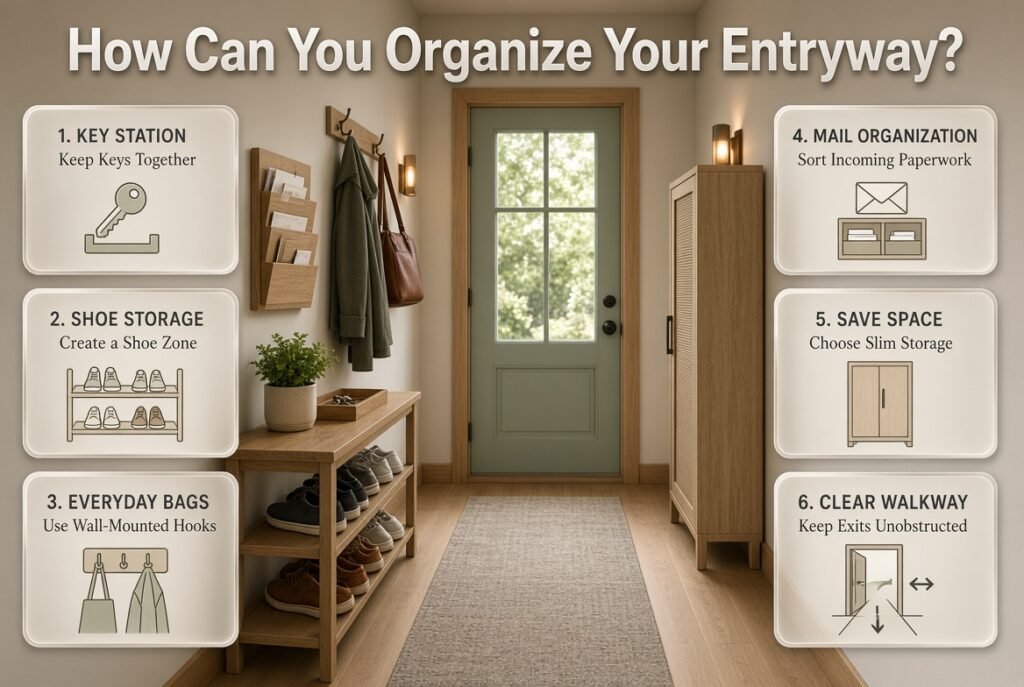
The entryway is where everyday items enter and leave the home, making it one of the most useful places to establish a simple organization system. A designated location for keys, shoes, bags, and incoming mail can prevent clutter from spreading into other rooms.
Start by identifying what usually accumulates near your entrance.
Create a practical arrangement that may include:
- A tray or hook for keys.
- A shoe rack or designated shoe area.
- Hooks for frequently used bags and jackets.
- A small container for items that need to leave the house.
- A folder or tray for incoming paperwork.
If space is limited, wall-mounted hooks and narrow storage furniture may be more suitable than a large cabinet.
Keep the walkway clear, especially near the front door and emergency exits.
Review the area regularly so that packages, shoes, and miscellaneous belongings do not become permanent fixtures.
How Should You Organize a Home Office?
An organized home office makes work materials easier to find and reduces distractions caused by crowded surfaces, tangled cables, and unmanaged paperwork. Start by separating active work supplies from reference materials and items you only use occasionally.
Organize Your Desk According to Your Workflow
Keep the items you use most often close to your working position.
These may include a notebook, pens, computer accessories, headphones, and a frequently used reference document.
Move unrelated objects to another location and avoid using the desk as a general storage surface.
A desk does not need to be completely empty. It needs enough usable space for the work you perform.
Create a Paperwork Management System
Paperwork becomes difficult to manage when important documents are mixed with advertising, receipts, and notes.
Create separate categories such as:
- Action required.
- Documents to file.
- Reference materials.
- Recycling or secure disposal.
Review incoming paperwork regularly rather than allowing it to accumulate indefinitely.
Store confidential records securely and dispose of sensitive documents appropriately.
Organize Digital Files as Well
Home organization isn’t limited to physical belongings. Digital clutter can also make everyday work more difficult.
Create a clear folder structure for work documents, household records, photographs, and personal projects.
Use descriptive filenames and review duplicate or outdated files periodically. Back up important information and protect sensitive documents with appropriate security measures.
The goal is to make files easy to locate without creating an unnecessarily complicated folder system.
How Can You Maximize Storage in a Small Home?
Small-home organization depends on using available space carefully, reducing unnecessary possessions, and choosing storage that preserves comfortable movement. Vertical shelves, under-bed containers, multifunctional furniture, and well-planned cupboards can increase usable storage without requiring a larger home.
Use Vertical Space
Walls often provide useful storage opportunities, especially in compact apartments.
Consider wall-mounted shelves, hooks, tall bookcases, and appropriately installed storage units.
Keep frequently used items at a comfortable height. Reserve higher shelves for lightweight belongings that you access less often.
Always secure tall furniture and shelving properly, particularly in homes with children or pets.
Choose Multifunctional Furniture
Furniture that serves more than one purpose can be valuable when floor space is limited.
Examples include:
- Beds with built-in drawers.
- Storage ottomans for blankets.
- Benches with compartments.
- Extendable dining tables.
- Nesting tables that can be tucked away.
- Compact desks with drawers.
Measure the available space before purchasing furniture and check whether its storage is easy to access.
A large storage bed may offer useful capacity, for example, but it may not be appropriate for a room where drawers cannot open fully.
Make Use of the Space Behind Doors
Suitable over-door organizers can hold lightweight accessories, toiletries, or other small belongings.
Check the door’s clearance and weight capacity before installation. Avoid arrangements that interfere with door operation or create hazards.
In rented accommodation, consider removable solutions where suitable, but follow product instructions and check that the installation method will not damage the surface.
Use Corners and Unused Cupboard Space
Corners, narrow gaps, and the upper portions of cupboards can sometimes provide additional storage.
Shelf risers, stackable containers, and suitable corner shelves may help you use these areas more efficiently.
However, don’t fill every gap simply because it is available. Storage should remain accessible, easy to clean, and safe to use.
Measure Before Buying Storage Products
Measure the width, depth, and height of the available space.
Account for door hinges, drawer rails, handles, and any clearance needed to remove containers.
Compare these measurements with the dimensions of the proposed organizer. A product that fits on paper may still be inconvenient if it blocks access to other belongings.
Which Home Organization Products Are Worth Buying?
The most useful organization products solve a specific problem. Before buying anything, decide what needs to be stored, how frequently it will be used, and whether your existing furniture or containers can already do the job.
| Product | Best use | Important consideration |
|---|---|---|
| Drawer dividers | Cutlery, stationery, accessories | Measure the drawer first. |
| Clear containers | Suitable pantry supplies | Choose appropriate food-safe materials. |
| Storage baskets | Blankets, toys, everyday belongings | Consider dust and cleaning needs. |
| Under-bed boxes | Seasonal clothing and bedding | Check clearance and ventilation. |
| Wall shelves | Books and lightweight belongings | Secure installation is essential. |
| Labeled boxes | Seasonal items and household records | Keep labels accurate. |
| Cable organizers | Desk and entertainment areas | Preserve ventilation and access. |
| Shelf risers | Cupboards and pantry shelves | Check weight capacity and dimensions. |
| Over-door organizers | Lightweight accessories | Confirm door clearance. |
| Storage ottomans | Blankets and living room items | Ensure the lid and contents are easy to access. |
Start with inexpensive solutions you already own. Suitable trays, baskets, and sturdy boxes can often provide effective storage without additional spending.
Buy new products only when they improve accessibility, solve a space problem, or make an existing system easier to maintain.
How Can You Keep Your Home Organized Every Day?
Maintaining an organized home is easier when tidying becomes part of your existing routine rather than a separate, exhausting activity. Small resets prevent everyday belongings from spreading across surfaces and make larger cleaning sessions more manageable.
Establish a 10-Minute Daily Reset
Choose a time that suits your schedule, such as after dinner or before bed.
Use the time to restore order in the areas that matter most.
- Return misplaced belongings to their designated locations.
- Clear the kitchen and dining surfaces.
- Put away shoes, bags, and outerwear.
- Place laundry in the appropriate basket.
- Prepare essential items for the following day.
You don’t need to complete every household chore during this period.
The purpose is to reduce the amount of clutter that carries over into tomorrow.
Create a Flexible Weekly Routine
A weekly schedule can help you remember tasks that aren’t part of daily tidying.
For example:
- Monday: Review pantry supplies and refrigerator contents.
- Tuesday: Organize bathroom products and towels.
- Wednesday: Sort paperwork and household mail.
- Thursday: Review clothing and bedroom storage.
- Friday: Tidy the living room and entryway.
- Weekend: Complete one larger task or review the entire system.
Adjust the schedule according to your household’s needs. There is no benefit in following a rigid routine that becomes difficult to maintain.
Use the One-In, One-Out Principle
When you bring a new item into a category that is already full, consider whether an existing item should be donated, recycled, or discarded.
This principle can be particularly useful for clothing, decorative objects, mugs, toys, and household accessories.
However, it should remain flexible. Don’t discard useful or necessary belongings simply to follow a numerical rule.
The real purpose is to prevent unnecessary accumulation.
Make Tidying Easy for Everyone
If a home is shared, organization should not depend entirely on one person.
Use accessible storage, simple labels, and clear categories that household members can understand.
Children may find low baskets easier to use than high shelves. Other household members may prefer labeled drawers or dedicated cupboards.
Discuss recurring problems and adjust storage locations when necessary.
A system that supports cooperation is more sustainable than one that requires constant reminders.
What Are the Most Common Home Organization Mistakes?
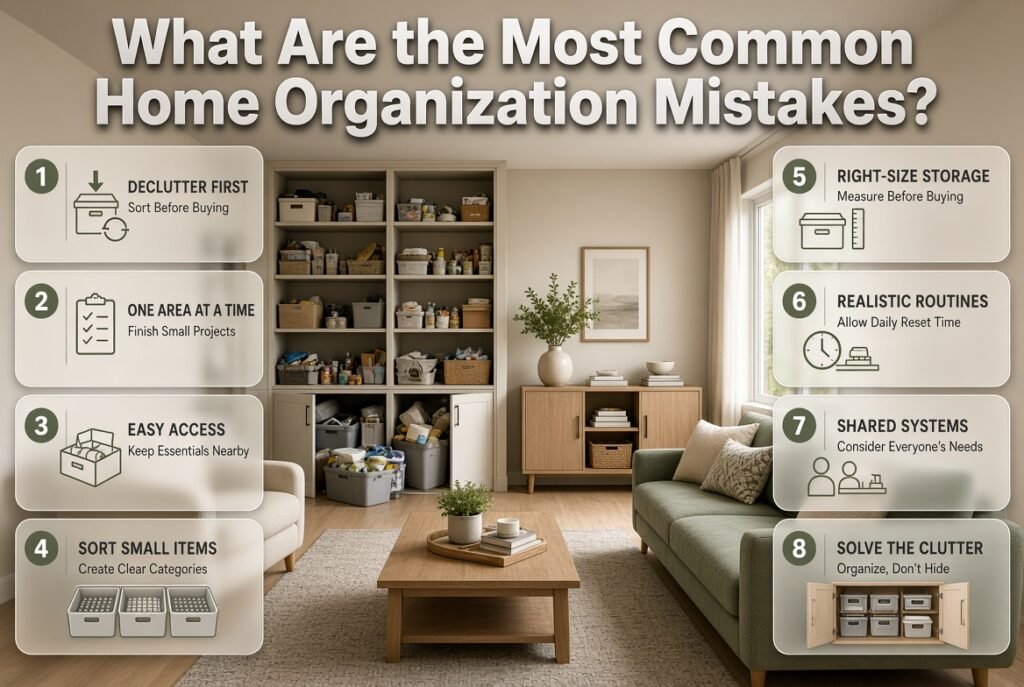
Many organization systems fail because they focus on appearance rather than convenience. A room may look excellent immediately after a cleanup, but if everyday belongings have no practical place, clutter can quickly return.
Mistake 1: Buying Organizers Before Decluttering
Why it happens: New storage products seem like a quick solution to a messy room.
Why it’s harmful: They can hide unnecessary belongings and consume space without solving the underlying problem.
How to avoid it: Sort your belongings first, remove what you no longer need, and measure the remaining storage requirements before shopping.
Mistake 2: Trying to Organize the Entire House at Once
Why it happens: People want immediate results and begin several rooms simultaneously.
Why it’s harmful: The project becomes difficult to finish, unfinished piles spread through the home, and motivation may decrease.
How to avoid it: Choose one manageable area and complete it before starting another. Divide larger projects into smaller sessions.
Mistake 3: Making Everyday Items Difficult to Reach
Why it happens: Attractive arrangements take priority over convenience, or daily essentials are placed in deep cupboards and high shelves.
Why it’s harmful: People may leave items on counters because returning them is inconvenient.
How to avoid it: Store frequently used belongings in accessible locations and reserve less convenient storage for occasional-use items.
Mistake 4: Keeping Too Many Miscellaneous Items
Why it happens: Small objects seem harmless individually and are often placed in drawers without being sorted.
Why it’s harmful: These collections become difficult to search and may conceal useful belongings.
How to avoid it: Create sensible categories, limit the space allocated to miscellaneous items, and review the collection periodically.
Mistake 5: Choosing Containers That Don’t Fit
Why it happens: A container looks attractive but hasn’t been measured against the intended space.
Why it’s harmful: Poorly sized products waste room, block drawers, and make items harder to reach.
How to avoid it: Measure shelves and drawers first. Consider weight, material, accessibility, and cleaning requirements.
Mistake 6: Expecting the Home to Stay Perfect
Why it happens: People assume a successful organization system should prevent all future clutter.
Why it’s harmful: Normal household activity creates mess, and small setbacks can make the entire system feel unsuccessful.
How to avoid it: Expect maintenance to be part of the process. Judge success by how easily you can restore order after everyday use.
Mistake 7: Ignoring the Needs of Other Household Members
Why it happens: One person designs the entire arrangement according to their own preferences.
Why it’s harmful: Other people may not understand the system or may find it inconvenient to follow.
How to avoid it: Consider who uses each area and make storage locations accessible and easy to understand.
Mistake 8: Hiding Clutter Instead of Addressing It
Why it happens: Putting everything into a cupboard or storage box creates an immediate visual improvement.
Why it’s harmful: Unsorted belongings remain difficult to locate, and the storage area may become overcrowded.
How to avoid it: Group items, remove unnecessary belongings, and use containers to support a clear storage plan rather than conceal an unresolved problem.
What Do Professionals Recommend for Long-Term Home Organization?
A practical organization system begins with understanding how a household uses its space. Instead of selecting storage products first, identify recurring problems, examine the available space, and choose solutions that make daily activities easier.
Organize by Frequency of Use
Divide belongings into three broad categories.
Everyday items: Things you use regularly, such as keys, cooking tools, and personal-care products. Keep them easy to reach.
Occasional-use items: Things you need weekly or monthly. Store them in secondary cupboards or drawers.
Seasonal or rarely used items: Belongings you need only at certain times, such as seasonal decorations or occasional-use equipment. Store them in appropriate, less accessible areas.
This approach makes prime storage locations available for the belongings that genuinely need them.
Establish Storage Limits
Each category should have a reasonable amount of space.
For example, designate a particular shelf for reusable shopping bags or a specific drawer for stationery. When the space becomes full, review the contents instead of automatically adding another container.
Storage limits help reveal when belongings are accumulating beyond what the household can comfortably accommodate.
Use Labels Where They Provide Real Value
Labels are helpful for pantry containers, shared cupboards, document folders, seasonal boxes, and children’s belongings.
However, labeling every object is rarely necessary.
Use labels when they reduce confusion, improve accessibility, or help people return belongings correctly. Keep them accurate and update them whenever the contents change.
Make Cleaning Part of the Design
An organized room should also be easy to clean.
Avoid overcrowding shelves, placing unnecessary items on the floor, or choosing storage products that are difficult to move.
Keep frequently cleaned surfaces relatively clear and ensure that furniture does not obstruct access to important areas.
A storage system that creates more cleaning work may need to be simplified.
Review Your Home Seasonally
Household needs change. Clothing sizes, hobbies, work arrangements, family routines, and storage requirements may all evolve.
Review the areas that have become difficult to maintain every few months or whenever your circumstances change.
Remove unnecessary belongings, adjust storage locations, and replace unsuitable solutions.
You don’t need to reorganize everything each season. Focus on the areas where your existing system no longer works.
For more practical inspiration, visit Heartomenal and explore ideas for creating a home that balances comfort, appearance, and everyday functionality.
How Can You Create a Simple Home Organization Plan?
A home organization plan helps turn broad intentions into manageable tasks. Instead of attempting a complete transformation, identify your priorities, set realistic time limits, and decide how you’ll maintain each improvement.
Use this five-stage plan as a starting point.
Stage 1: Assess Your Home
Walk through each room and identify its main organization problems.
Write down recurring issues such as crowded surfaces, overfilled cupboards, misplaced items, or difficult-to-clean areas.
Choose the three problems that cause the greatest inconvenience.
Stage 2: Prioritize High-Impact Areas
Start with areas that affect your daily routine.
For many households, these include the kitchen, entrance, bathroom, and bedroom. However, the best starting point depends on your own circumstances.
If you work from home, an overcrowded desk may be more important than a decorative storage shelf.
Stage 3: Declutter and Arrange
Work through one area at a time.
Remove unwanted belongings, group similar items, and assign suitable storage locations.
Measure the available space before buying organizers, and test the arrangement before expanding it.
Stage 4: Establish Maintenance Habits
Create a short daily reset and a flexible weekly review.
Make sure each household member understands where commonly used belongings belong.
When a system repeatedly fails, identify the cause and adjust the arrangement.
Stage 5: Review Your Progress
After a few weeks, consider whether the changes have improved your daily routine.
Ask yourself:
- Can I find essential belongings more easily?
- Are counters and walkways less crowded?
- Has cleaning become simpler?
- Can household members maintain the system?
- Are there storage arrangements that still feel inconvenient?
Use your answers to improve the system rather than adding unnecessary complexity.
What Are the Best Smart Home Organization Tips for Keeping Every Room Clutter-Free?
The best smart home organization tips focus on creating practical storage systems that match your daily routine. Instead of simply hiding belongings in cupboards, organize each room according to its purpose, keep frequently used items within easy reach, and remove things that no longer serve a useful function. A kitchen benefits from activity-based storage, a bedroom needs an accessible wardrobe system, and a living room works better when everyday accessories have designated places.
Consistency is equally important. A home doesn’t need to remain perfectly tidy throughout the day, but returning items to their proper locations makes it easier to restore order without spending hours cleaning.
Practical points to follow:
Assign a specific place to frequently used belongings.
Declutter one drawer, shelf, or room at a time.
Keep countertops and walkways clear wherever possible.
Use baskets, drawer dividers, and shelves only when they solve a genuine storage problem.
Establish a short daily reset to prevent clutter from accumulating.
How Can I Organize a Small Home to Maximize Space Without Spending Too Much Money?
Organizing a small home starts with making better use of existing space rather than immediately purchasing new furniture or storage products. Remove unnecessary belongings, group similar items together, and identify underused areas such as the space beneath beds, the inside of suitable cupboard doors, and empty vertical wall space. These changes can increase usable storage while keeping rooms comfortable and accessible.
Affordable solutions often work just as well as expensive organizing systems. Reusing suitable boxes, baskets, trays, and containers can help separate belongings without adding unnecessary costs. Before buying anything, measure your available storage space and decide exactly what needs to be organized.
Budget-friendly organization strategies:
Use existing containers to group small belongings.
Install suitable wall shelves when additional vertical storage is needed.
Store seasonal clothing and spare bedding in appropriate under-bed containers.
Choose multifunctional furniture when it genuinely saves space.
Avoid buying organizers before decluttering and measuring cupboards.
How Do I Keep My Home Organized Every Day With a Busy Schedule?
Maintaining an organized home with a busy schedule requires simple routines that fit naturally into everyday life. Rather than waiting until clutter becomes overwhelming, spend a few minutes returning misplaced items, clearing frequently used surfaces, and preparing essential belongings for the next day. These small actions reduce the amount of work required during weekly cleaning.
The most effective routine is one that remains realistic when you’re tired or short on time. Focus on high-impact areas such as the kitchen, entrance, and living room instead of expecting every room to look perfect every day. If a particular area repeatedly becomes messy, review its storage arrangement to determine whether putting items away is unnecessarily difficult.
Daily habits that make a difference:
Spend 5–10 minutes resetting important areas.
Return keys, bags, shoes, and everyday accessories to designated locations.
Clear kitchen counters after meal preparation.
Put laundry in its appropriate basket instead of leaving it on furniture.
Divide larger organization tasks across the week.
Encourage household members to maintain shared spaces.
What Are the Most Useful Home Organization Products for Reducing Clutter?
The most useful home organization products are those that solve specific problems, improve accessibility, and make belongings easier to maintain. Drawer dividers are helpful for small accessories, transparent containers can simplify suitable pantry storage, and labeled boxes make seasonal belongings easier to identify. For smaller homes, wall shelves and multifunctional furniture may provide additional storage without taking up excessive floor space.
However, buying more organizers doesn’t automatically create a more organized home. Too many baskets, boxes, and containers can occupy valuable space or conceal belongings that should have been removed. Choose products according to your actual storage needs, available dimensions, and the frequency with which you use the items.
Useful products to consider:
Drawer dividers: Separate kitchen utensils, stationery, and accessories.
Storage baskets: Group blankets, toys, and frequently used household items.
Clear containers: Make suitable pantry supplies easier to identify.
Under-bed storage boxes: Accommodate seasonal clothing and spare bedding.
Wall-mounted shelves: Use vertical space for books and lightweight belongings.
Cable organizers: Keep electronic accessories and wires arranged neatly.
What Are the Biggest Home Organization Mistakes, and How Can I Prevent Clutter From Returning?
One of the biggest home organization mistakes is purchasing storage products before deciding which belongings are actually worth keeping. Another is creating an arrangement that looks attractive but is inconvenient to use. When everyday items are difficult to reach or have no obvious storage location, people naturally leave them on counters, tables, and other convenient surfaces. Clutter then returns even after a thorough cleanup.
Preventing this problem requires a combination of decluttering, practical storage, and consistent maintenance. Every frequently used item should have a convenient home, and the organization system should reflect the habits of everyone who shares the space. Periodically reviewing crowded drawers and cupboards also helps prevent unnecessary accumulation.
Professional recommendations:
Declutter before investing in new storage products.
Keep everyday essentials in accessible locations.
Avoid filling every shelf and cupboard to capacity.
Create simple categories instead of collecting unrelated items in miscellaneous boxes.
Review belongings before purchasing additional items in already crowded categories.
Adjust storage arrangements that repeatedly fail.
Focus on sustainable routines rather than maintaining a perfectly tidy home.
The key to lasting home organization is not eliminating every sign of daily activity. It’s creating a practical system that makes tidying easier, uses available space efficiently, and supports your household’s real needs.
Conclusion
Smart home organization is not about buying more storage products or making every room look perfect. It is about creating practical systems that make everyday life easier, reduce clutter, and help you use your space more efficiently. Whether you live in a small apartment or a spacious house, the best results come from understanding your needs, giving every frequently used item a designated place, and choosing storage solutions that fit your routine.
Start with one area at a time instead of trying to organize your entire home in a single day. Remove items you no longer need, make better use of vertical space, organize drawers and cabinets, and keep everyday essentials within easy reach. Simple habits, such as returning items after use, resetting busy areas each evening, and reviewing storage spaces regularly, can prevent clutter from building up again.
The most effective organization system is one you can maintain without unnecessary effort. Focus on convenience, accessibility, and consistency rather than perfection. With a few thoughtful changes and realistic daily routines, you can create a home that feels more comfortable, functions better, and supports your lifestyle throughout the year.
Leave a Reply